A year ago, my weekdays ran me. I fell asleep on the commuter train — both directions — and snapped awake more than once close to missing my stop. I’d lie down to put my kids to bed and fall asleep beside them, and that was the end of my evening. I had no energy to play with my own children. At work I stress-ate and bought lunch out almost every day because deciding what to eat, let alone making it, felt like one thing too many. I described myself at the time as “just getting by,” and it was accurate.
What changed was not motivation. Motivation had failed me reliably for about a decade. What changed is that I stopped relying on how I felt on any given day and built a small set of weekly routines that run almost on rails: a fixed wake time, a one-hour meal prep on Sundays, a fifteen-minute packing pass each night, and training slots that are treated like meetings. In the past three months I’m down about 35 pounds, my evenings are mine again, and the system has survived sick kids, work crunches, and bad weeks — because it was designed for them.
This is the whole system, in the order I built it, so you can copy it.
Not medical advice — this is one parent’s routine and the general evidence behind routines like it. Health conditions, injuries, and medications change what makes sense for you; that’s a conversation for your doctor.
Why routines beat motivation
Motivation is a weather report. It changes with sleep, stress, weather, and whatever your toddler did at 5 a.m. Routines are climate — they’re what your week looks like regardless of how Tuesday feels.
The research on habit formation backs this up. A widely cited University College London study on how habits form found that repeating a behaviour in a consistent context made it progressively more automatic — but it took weeks to months, not days, and it varied a lot by person and behaviour. The implication matters: for the first stretch, a routine feels like effort because it is effort. The payoff comes when the behaviour stops requiring a decision. I don’t decide whether to pack lunches anymore, any more than I decide whether to brush my teeth. It’s just what happens at 7:30.
That’s the real mechanism of everything below: remove decisions, attach each habit to a fixed time or an existing event, and make the default the healthy option. Willpower is then reserved for actual emergencies, which — with two young kids — arrive often enough on their own.
The anchor: wake time
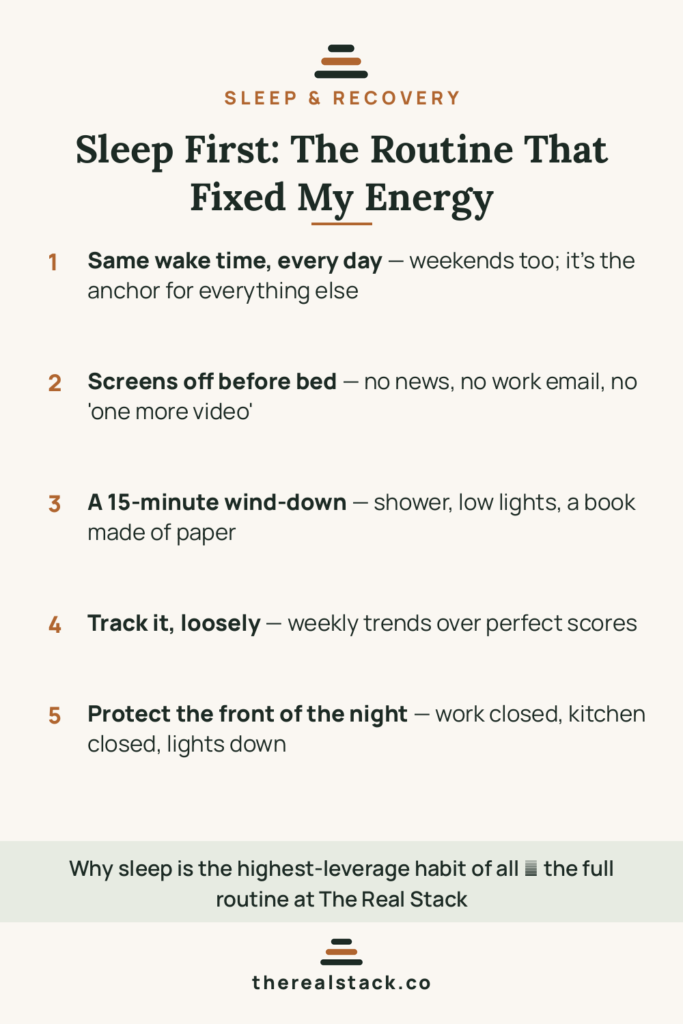
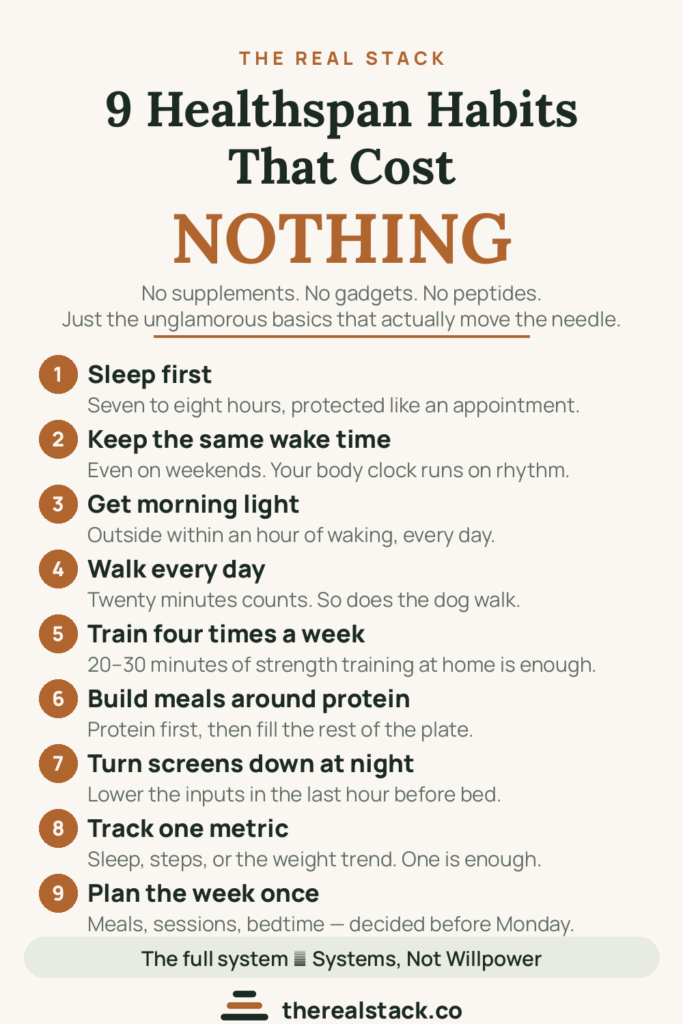
Every routine in this article hangs off one: I get up at the same time every day, weekends included, within about half an hour.
It sounds like a sleep tip. It’s actually the load-bearing wall of the whole system. A fixed wake time makes sleepiness arrive on schedule at night. It creates the early-morning slot where training can happen before the house wakes. It sets the rhythm that the evening packing pass and wind-down attach to. Large cohort research — including UK Biobank analyses of sleep regularity — associates consistent sleep and wake timing with lower mortality risk, independent of how long people sleep, which is a good reason to treat regularity as a health behaviour in its own right and not just a productivity trick.
If you build nothing else from this article, build the anchor. (I wrote up the full sleep routine — screens off, wind-down, tracking — here: Sleep: The Highest-Leverage Healthspan Habit Nobody Can Sell You.)
The Sunday prep: one hour, nine lunches
This is the routine that killed the bought lunches, most of the stress eating, and a surprising amount of money. It is deliberately boring, because boring repeats.
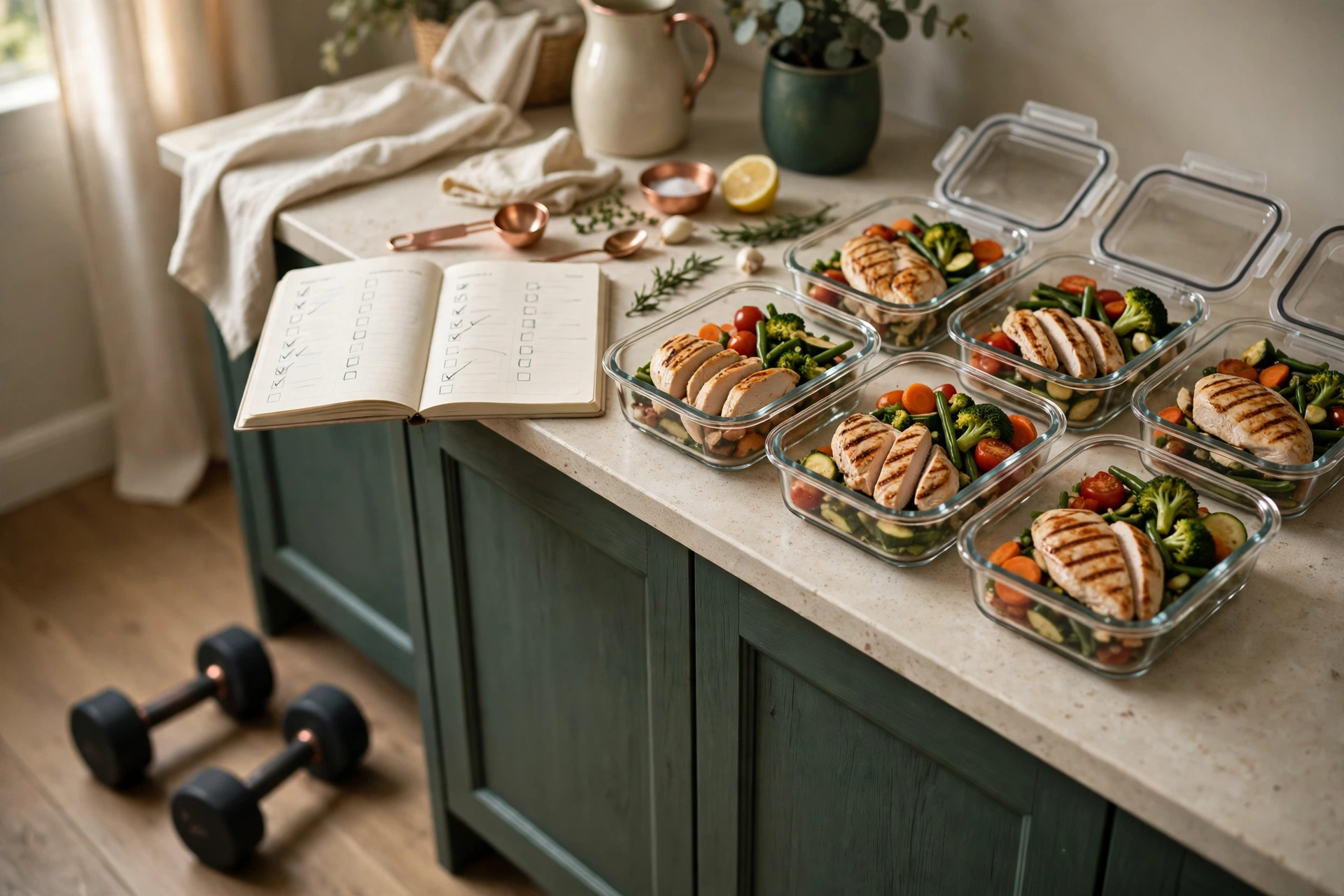
The formula never changes: one protein, one grain, one vegetable, one fruit.
- Protein: chicken breast, cooked in one big batch — oven or grill, simply seasoned.
- Grain: rice or quinoa, in the rice cooker, hands-off.
- Vegetable: baby carrots — no cooking, no chopping, portioned straight into containers.
- Fruit: apples, one per container.
The output: about nine complete lunches — work lunches for my wife and me across the week. Nine containers, lids on, stacked in the fridge. Total active time is roughly an hour on a Sunday, most of it waiting for the oven and the rice cooker.
The practical details that make it work:
- Same shopping list every week. Chicken, rice or quinoa, baby carrots, apples. I can buy it half-asleep, and half the weeks, I do.
- Containers you like. Uniform containers that stack and seal properly. It sounds trivial; a fridge full of mismatched lids is where meal prep goes to die.
- Mind the fridge window. Standard food-safety guidance puts cooked meals at about three to four days in the fridge, so the late-week containers go in the freezer on Sunday and move to the fridge the night before they’re needed. Build that into the routine once and you never think about it again.
- Good enough beats interesting. By Thursday the chicken-and-rice is not exciting. That’s fine. It’s fuel that removes a daily decision and a daily $15 problem. Variety lives at dinner.
Observational research on home food preparation — including studies published in the International Journal of Behavioral Nutrition and Physical Activity — associates cooking and eating at home more often with better overall diet quality. I can’t promise you the mechanism from a study, but I can tell you the mechanism in my kitchen: when a decent lunch is already in the fridge with my name on it, the food truck stops being a temptation and starts being an errand I don’t need.
The nightly pass: fifteen minutes at 7:30
Every evening, after dinner, one pass through the kitchen — about fifteen minutes:
- Tomorrow’s lunch for me, moved to the front of the fridge, ready to go straight into my bag in the morning.
- Tomorrow’s lunch for my wife, same thing.
- My son’s school lunch, packed fresh the night before.
Three lunches, one pass, done while the kitchen is already being tidied. This tiny routine does an outsized amount of work. It removes the morning scramble entirely. It removes the mid-morning “I forgot my lunch, I’ll just buy something” failure mode, which was previously my default setting. And because it’s attached to an event that always happens — dinner cleanup — it doesn’t need its own motivation.
Training slots: protected like meetings
I train with dumbbells at home, four times a week, in short sessions — before the house wakes up or after the kids are down, depending on the day. Three things make it stick:
- It’s at home. No commute, no gym bag, no weather excuse. The dumbbells are ten steps away.
- The slots are fixed. Same days, same rough times, treated like meetings I don’t reschedule for feelings. What gets protected gets done.
- Short counts. A focused 30 minutes, done consistently for months, outperforms the heroic two-hour session I used to plan and skip. On genuinely wrecked days, the session shrinks — lighter, shorter — but it doesn’t disappear. (More on why that rule matters below.)
- My wife is in it with me. When our schedules allow — and with two young kids, that’s some sessions, not all — we train together. It’s the accountability mechanism that actually works: a solo promise to yourself is easy to quietly renegotiate at 6 a.m., but when your partner is standing in the room expecting you, you show up. It also turns a chore into one of the few half-hours in our week that’s genuinely ours.
The fallback: the dog walk counts
Some days the workout just isn’t in me. The old version of me called those days zero days — all or nothing, and nothing won a lot. The system version has a floor instead: I take the dog out for a real walk. It’s movement, it’s daylight, and with a good podcast or some music in my ears it’s honestly something I look forward to — headspace, not a consolation prize. A walk is not a failed training day; it’s the minimum effective day, and keeping the minimum is what keeps the streak — and the habit — alive. This is the same rule as the collapse section below, applied to an ordinary tired Tuesday: shrink, don’t quit.
The money, roughly
I’ll label this clearly: this is my rough personal math, not a statistic.
A bought lunch near work ran me roughly $15–20 — call it $300–400 a month — and that was before the stress-eating extras: the afternoon coffee run, the vending-machine or bakery stop on a bad day. A prepped lunch of chicken, rice or quinoa, carrots, and an apple costs a few dollars in ingredients — my rough estimate is $4–6 a meal. Across two adults eating prepped lunches through the work week, the system put a few hundred dollars a month back in our account. I did not expect a health habit to be one of the better financial decisions I made this year, but there it is.
The one-page weekly template
Copy this onto a note on your fridge. Adjust the times; keep the shape.
Every day
- Wake at ___ (same time, weekends too)
- Screens off at ___ (phone down, screen time kept to a minimum)
- 7:30 p.m. packing pass: my lunch, partner’s lunch, kid’s school lunch
Sunday (≈1 hour)
- Shop the standing list: protein, grain, vegetable, fruit
- Cook the batch; portion ~9 containers; freeze the late-week ones
- Glance at the week: confirm training slots around real life
Training days (pick 4)
- Session 1 ___ Session 2 ___ Session 3 ___ Session 4 ___
Friday (5 minutes)
- What worked? What slipped? Adjust one thing — only one.
What makes it fall apart — and how to restart
It does fall apart. A kid gets sick and the night goes sideways. Travel eats a Sunday. Work detonates a week. Here’s what I’ve learned about the collapses:
Shrink, don’t quit. A bad week gets the miniature version: wake time holds, packing pass holds, training becomes ten easy minutes, and the prep becomes a rotisserie chicken and a bag of salad. The shape survives even when the quality dips — and keeping the shape is everything, because restarting a shape you never fully dropped is easy.
Restart at the anchor. When a week truly blows up, I don’t rebuild everything on Monday. I fix the wake time first. Sleep steadies, energy returns, and the other routines get rebuilt one at a time over the following days, in the same order I built them originally.
Expect the restart to feel unfair. The habit research says automaticity takes weeks to months, and a disrupted routine needs a few repetitions to feel normal again. Three or four rough days after a collapse is not failure; it’s the known cost of re-entry. Budget for it mentally and it stops being a reason to quit.
Never let a missed day become a verdict. The old me treated a blown day as proof the whole project was over. The system version of me treats it as weather. The routine is still there tomorrow at 7:30.
The bottom line
I didn’t get my evenings back by trying harder. I got them back by sleeping on a schedule, spending one hour on Sunday removing five days of food decisions, spending fifteen minutes each night removing the morning chaos, and treating four short training sessions like appointments. None of it is impressive. All of it compounds.
If you build only one piece, build the anchor — the sleep routine is where my whole turnaround started, and it’s written up in full here: Sleep: The Highest-Leverage Healthspan Habit Nobody Can Sell You.
This article reflects personal experience and general education; it is not medical advice. See our Disclaimer & Disclosure page.