
Disclosure: this article contains affiliate links, including my Whoop referral link. If you buy through them, I may earn a commission at no extra cost to you.
Let me tell you what actually started my turnaround. It wasn’t a supplement, a peptide, a wearable, or a program. It was deciding — in my early 40s, with a 4-year-old, a 2-year-old, and a demanding job — that sleep was the main event instead of whatever was left at the end of the day.
And I mean main event, because my baseline was genuinely bad. I was falling asleep on the commuter train — in both directions — and more than once I snapped awake close to missing my stop. At home, I’d lie down to put the kids to bed and fall asleep beside them, losing the entire evening. I wasn’t a guy with a sleep habit problem. I was a guy running on fumes and calling it normal.
In the past three months I’ve lost about 35 pounds (from roughly 240 to 205), trained more consistently than I have in a decade, and stopped feeling like I was running on fumes by 3 p.m. Almost everything I changed came after sleep, and most of it only became possible because of sleep. This article is the routine, why it works according to the research, and how to run it in a house with small children.
Not medical advice — just one person’s experience plus the published evidence. If you snore heavily, stop breathing at night, or have insomnia that won’t budge, that’s a conversation for your doctor, possibly a sleep study. No blog post substitutes for that.
Why sleep is the lever
Healthspan — the years you live well, able to move, think, train, and keep up with your kids — runs on a handful of systems: metabolic health, cardiovascular health, brain health, muscle and bone. Sleep touches all of them, which is why researchers keep landing on it as foundational:
- Metabolism and appetite. Sleep restriction studies — including controlled lab work summarized by the U.S. Centers for Disease Control and Prevention and in reviews of sleep and obesity — consistently show that short sleep shifts appetite hormones (ghrelin up, leptin down) and increases calorie intake, especially from snack foods. When I was sleeping badly, my “willpower problem” with food was mostly a sleep problem wearing a disguise.
- Training and recovery. Sleep is when most growth-hormone release and tissue repair happens, and sleep-extension studies in athletes (the Stanford basketball sleep study is the famous one) show improved performance with more sleep. In practical terms: my dumbbell sessions went from something I endured to something I progressed at, once I was sleeping properly.
- Brain and mood. Sleep loss degrades next-day focus, emotional regulation, and decision-making in basically every study design ever run on it. With two young kids, patience is a health metric. Sleep is how I got more of it.
- The guidelines aren’t exotic. The American Academy of Sleep Medicine and the Canadian 24-Hour Movement Guidelines both land in the same place: adults need roughly 7–9 hours of good-quality sleep, on a regular schedule. The regularity part matters more than most people realize — research on sleep regularity (including large cohort analyses from the UK Biobank) associates consistent sleep/wake timing with lower mortality risk, independent of duration.
None of this requires a purchase. That’s precisely why nobody markets it to you.
My actual routine
This is what I do, with a full-time job and two kids under five. It’s deliberately unglamorous.
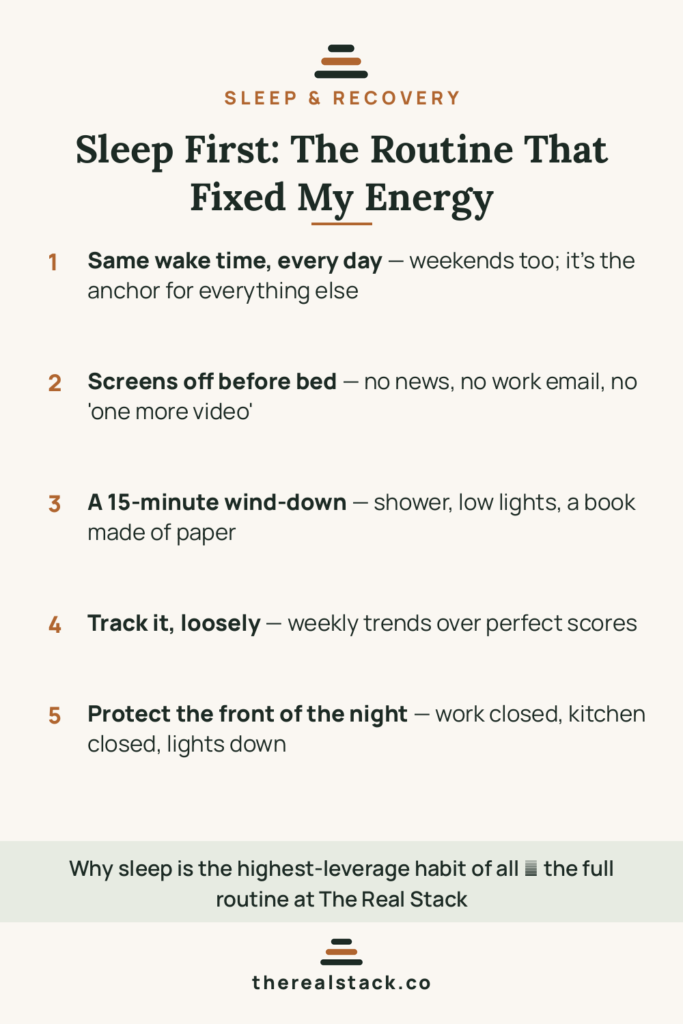
- Same wake time, every day — including weekends. This is the anchor. I get up at the same time within about a 30-minute window, seven days a week. It’s the single most powerful tool for stabilizing everything downstream: sleepiness arrives on schedule at night, and mornings stop being a negotiation. Sleeping in on Saturday felt like a reward; it was actually jet lag I gave myself weekly.
- Screens off before bed. In the last stretch before bed, I put the phone down and keep screen time to a minimum. The research here is consistent: evening light exposure and engaging content both delay sleep onset (work on evening light-emitting e-readers, published in PNAS, is a clean demonstration). But honestly, the bigger effect for me was behavioural — no news, no work email, no “one more video” at 11:40 p.m. The bedroom got boring, and boring is what you want.
- A wind-down that’s short enough to survive real life. Shower, lights low, a few minutes of stretching or reading something made of paper. Fifteen minutes, not an hour-long ceremony. A routine you’ll do at 80% compliance beats a perfect one you abandon in week two — especially on nights when bedtime with the kids runs long, which is most nights.
- Track it — but loosely. I wear a Whoop, mainly for sleep and recovery trends. What tracking actually taught me: my perceived sleep and my actual sleep were different things; alcohol — even a modest amount — visibly wrecked my recovery scores and my next day; and late, heavy meals cost me more sleep quality than caffeine timing did. I don’t chase a perfect score. I look at the week’s trend the way you’d glance at a fuel gauge. If you don’t want a wearable, a notebook with bed/wake times and a 1–10 morning rating gets you 70% of the insight for $4.
- Protect the front end of the night. With young kids, the hours after they’re down are the only adult hours in the day — I know exactly how precious they feel. I still guard a hard-ish stop: work closed, kitchen closed, lights down. The trade is real (less evening leisure) and worth it (a morning self who can train, work, and be patient). Nobody in my house misses the version of me who stayed up scrolling and paid for it until noon.
What changed — honestly
- Energy. The 3 p.m. crash mostly disappeared. Not “optimized” — just normal, stable energy, which at this stage of life feels like a superpower.
- Training. Four dumbbell sessions a week, consistently, for the first time in years. Consistency was never a motivation problem; it was a recovery problem.
- Weight. ~35 pounds in the past three months. Sleep didn’t burn the fat — eating mostly whole foods, adequate protein, creatine, and training did the mechanical work. But sleep made all of it sustainable: fewer cravings, better training, better decisions at 9 p.m. in front of the fridge.
- Evenings, and my kids. I stopped falling asleep during bedtime stories. My evenings exist again — and instead of counting the minutes until I could sit down, I have the energy to get on the floor and play with my kids after dinner. Of everything on this list, that’s the one I’d have paid the most for.
- Mood and patience. The least measurable and the most valuable. I am a better parent on seven-plus hours. It’s not close.
Your first two weeks
Don’t rebuild your life. Do this:
- Pick a wake time you can hold seven days a week. Set the alarm. That’s the whole first step.
- Count backwards 8 hours. That’s your lights-out target — aim to be in bed then, not starting to get ready then.
- Screens off for the last stretch before bed starting tonight. A $10 alarm clock removes the “I need my phone” excuse.
- Track bed time, wake time, and a 1–10 “how do I feel” score each morning. Paper is fine.
- After two weeks, look at the pattern — not any single night — and adjust one thing.
That’s it. No stack, no protocol, no subscription. If you do only this, you will have done more for your healthspan than any compound this site will ever write about — including the famous ones.
The bottom line
Peptides promise recovery, resilience, and more good years. Sleep delivers measurable versions of all three, in actual human studies, for free, starting tonight. It’s not the whole program — training, food, and bloodwork matter, and this site covers all of them. But it’s the first domino, and in my house, it was the one that knocked over all the others.
Start tonight. Same time tomorrow morning. I’ll be doing the same.
Sources and further reading: American Academy of Sleep Medicine & Sleep Research Society consensus recommendation on adult sleep duration (7+ hours); Canadian 24-Hour Movement Guidelines for Adults (7–9 hours of good-quality sleep on a regular schedule); CDC resources on sleep and chronic disease; reviews of sleep restriction, appetite hormones, and energy intake in the sleep–metabolism literature; the Stanford sleep-extension study in collegiate basketball players (Sleep, 2011); evening light-emitting e-reader study (PNAS, 2015); UK Biobank cohort research on sleep regularity and mortality.
This article reflects personal experience and general education; it is not medical advice. Persistent snoring, witnessed apneas, or chronic insomnia warrant a medical assessment. See our Disclaimer & Disclosure page.
Leave a Reply