
Disclosure: this article contains affiliate links, including my Whoop referral link. If you buy through them, I may earn a commission at no extra cost to you.
Full disclosure before anything else, because this site runs on it: I wear a Whoop every day. I have never worn an Oura Ring. I researched the ring hard before choosing — including the Ring 5 that launched in May 2026 — and I stayed with the band. This article is why, what I gave up by choosing it, and the kind of person who should make the opposite call.
If you’re deciding between these two, the spec sheets won’t settle it. Both track sleep, heart rate variability, resting heart rate, and recovery-style scores. Both are screenless. Both want a subscription. The real differences are form factor, total cost over years, battery life, and what each one is actually optimizing for — training load, or sleep and readiness.
Not medical advice, and neither device is a medical device. This is one person’s experience plus published specs and validation research. Prices are Canadian where I could verify them, checked November 2026 — confirm before you buy, because both companies adjust pricing.
The two products, as they stand in late 2026
Whoop 5.0 (and the medical-grade MG). A screenless fabric band you wear on your wrist around the clock. Whoop doesn’t sell hardware — you buy a membership and the band comes with it:
- One — CA$259/year: Whoop 5.0, basic wired charger, core recovery/strain/sleep tracking
- Peak — CA$349/year: adds the wireless PowerPack (charges on your wrist) and the Healthspan, Health Monitor, and stress features
- Life — CA$529/year: the Whoop MG, which adds ECG and blood-pressure trend insights (the ECG and irregular-rhythm notifications are Health Canada licensed)
Battery is rated at 14+ days. Stop paying and the band stops working — the membership is the product.
Oura Ring 5 (and the Ring 4). A titanium ring, a few grams, that reads as jewelry. You buy the hardware, then pay for the app:
- Ring 5 — from CA$529 (premium finishes CA$649): 40% smaller than the Ring 4, battery rated 6–9 days
- Ring 4 — from CA$469: still sold, same app and same scores, battery 5–8 days
- Membership — CA$7.99/month or CA$89.99/year after a free first month; without it, the ring’s detailed scores and trends are locked
The third option: Ultrahuman Ring AIR. A newer, smaller player worth knowing about, because it breaks the pattern above: no subscription at all. The ring lists at CA$479.99 at Best Buy Canada (it’s discounted often — check before paying list), and the app’s core features are included for life. Titanium, about 2.4 g at the smallest sizes, battery rated up to 6 days. It tracks the same core signals — sleep, HRV, resting heart rate, skin temperature — and builds its own recovery and strain-style scores around them. The trade-offs: a younger, smaller company, a thinner evidence base than Oura’s, and an app that’s still maturing. I haven’t worn this one either — it arrived into a decision I’d already made — but if the subscription model is your main objection to both devices above, this is the one that answers it.
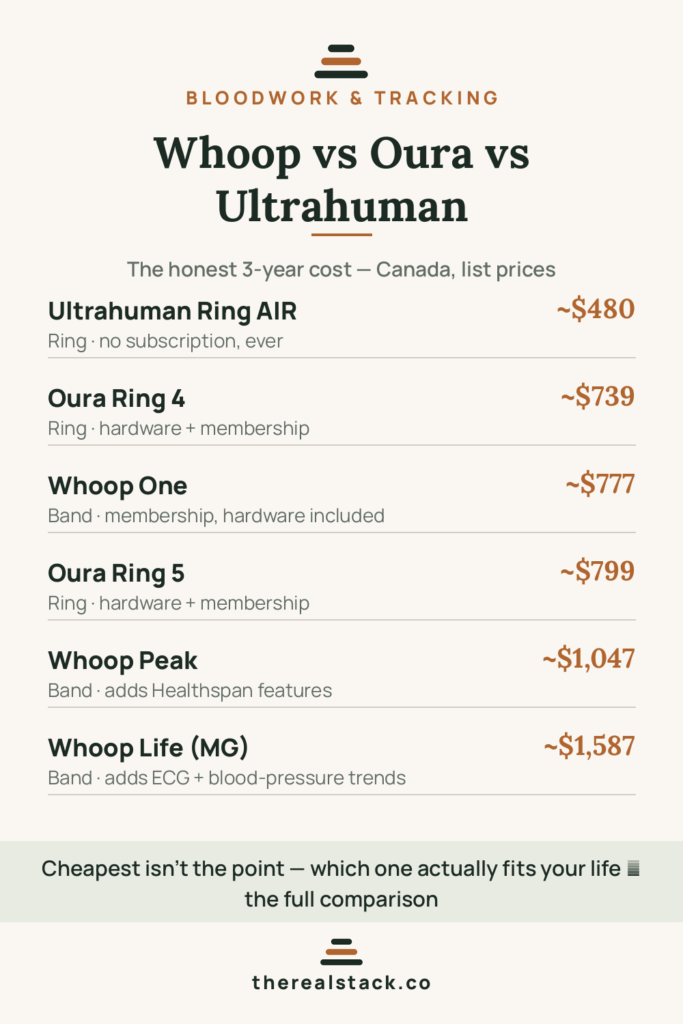
The honest 3-year math (Canada)
Sticker prices lie; three-year totals don’t:
| Up front | 3 years of fees | 3-year total | |
|---|---|---|---|
| Ultrahuman Ring AIR | CA$479.99 | CA$0 | ~CA$480 |
| Oura Ring 4 | CA$469 | 3 × CA$89.99 | ~CA$739 |
| Whoop One | CA$0 | 3 × CA$259 | ~CA$777 |
| Oura Ring 5 | CA$529 | 3 × CA$89.99 | ~CA$799 |
| Whoop Peak | CA$0 | 3 × CA$349 | ~CA$1,047 |
| Whoop Life (MG) | CA$0 | 3 × CA$529 | ~CA$1,587 |
Two things jump out. First, the Ultrahuman is now the cheapest way into this category over three years — one payment, no fees — with the Ring 4 next, still cheaper than Whoop’s entry tier. Second, the gap between “entry Whoop” and “entry Oura” is small enough that cost alone shouldn’t decide it. The tier you actually want matters more: the moment you want Whoop’s Healthspan features or the MG’s ECG, you’re paying meaningfully more than either ring.
Where Whoop wins (for me)
Training is the point. I train with dumbbells at home four days a week, 20–30 minutes a session. Whoop is built around strain — how hard today was, and whether tomorrow should be hard too. That framing matches how I actually make decisions: push, or back off. Oura’s Readiness score answers a similar question, but Whoop’s whole app is organized around training load in a way the ring’s isn’t.
A ring and dumbbells don’t mix. This one is practical, not theoretical. Gripping dumbbells with a titanium ring on your finger is uncomfortable at best and a pinch risk at worst — lifters generally take rings off to train. A band on the wrist (or bicep) just stays on. For someone whose training is the reason they track at all, that’s close to decisive.
Battery I can forget about. 14+ days, and on Peak it charges on my wrist while I wear it. With two kids under five, “remember to charge the tracker” is a chore that loses. The ring’s 6–9 days is fine — it’s just one more thing on the list.
Sleep tracking without a screen. Both devices are screenless, which I consider a feature. My sleep routine (the full article is on this site) depends on the bedroom being boring. A band that never buzzes or glows fits that; so does the ring, honestly. Tie.
Where Oura wins (and what I gave up)
It’s invisible. A ring disappears into a workday, a suit, a wedding photo. A fabric band on your wrist reads “fitness person” in every meeting. If discretion matters — client-facing work, formal settings — the ring wins and it isn’t close.
The sleep and HRV research is stronger. Oura’s overnight HRV has independent validation behind it (including an Air Force Research Laboratory–funded study in 2025 where the Ring 4 was the closest of five devices to reference measurements). Whoop 4.0’s overnight HRV showed moderate agreement with ECG in a 2025 study, and there’s no independent published validation of the 5.0 yet. If your primary use is overnight physiology — sleep quality, temperature trends, cycle tracking — Oura has the deeper evidence base.
Temperature trends. Oura’s skin-temperature deviation tracking is genuinely useful for spotting illness coming on and for cycle insights. Whoop tracks skin temperature too, but it’s not the headline feature it is on the ring.
You own something at the end. Cancel Whoop and you own a paperweight. Cancel Oura and you still own a ring (with a much dumber app). Over a decade, that ownership difference compounds.
Cycle and women’s health features. Not my use case, but if you’re buying for a partner or comparing for a household, Oura’s cycle insights are a real differentiator Whoop doesn’t match.
The accuracy question, honestly
Both devices are good at the things optical sensors are good at: resting heart rate, sleep/wake detection, and overnight HRV trends. Both are weaker at the things optical sensors are bad at: precise sleep-stage breakdowns (light/deep/REM percentages are estimates, not measurements — true staging needs a sleep lab) and heart rate during hard intervals.
The practical takeaway: trust the trends, distrust the single-night score. A week of declining HRV and rising resting heart rate means something. One red recovery morning after a late, salty dinner mostly means you had a late, salty dinner. Whichever device you buy, that rule will save you from more bad decisions than the hardware choice will.
Who should buy which
Buy the Whoop if: training drives your decisions; you lift (especially with anything you’d grip); you want strain/recovery coaching; you’d rather pay yearly all-in than buy hardware; two-week battery matters. If you go with Whoop, here’s my Whoop referral link — it gets you a free month, and it’s the one I’d send a friend.
Buy the Oura if: sleep and readiness are the point; you want something invisible at work; temperature trends or cycle tracking matter; you prefer owning hardware; the Ring 4’s 3-year cost (~CA$739) is the budget-friendly entry.
Buy the Ultrahuman if: the subscription is the deal-breaker; you want the ring form factor at the lowest 3-year cost (~CA$480, all-in); you’re comfortable trading a deep evidence base for a simpler deal.
Buy neither if: you won’t wear it every night for months. Both devices earn their keep through consistent data — baselines take weeks to establish. A tracker in a drawer has an accuracy of exactly zero, and the subscription still bills you.
My bottom line
I stayed with Whoop because I train with dumbbells four days a week and the strain/recovery loop is how I decide what tomorrow looks like. The ring is the better sleep device on the evidence, the better-looking device by a mile, and — in Ring 4 form — the cheaper one over three years. If my training ever stops being the center of my routine, I’d switch without much regret.
That’s the honest version. Your call depends on which question you’re actually asking the device: “How hard can I train today?” (band) or “How did I sleep, and am I ready?” (ring).
Sources: Whoop and Oura official product and membership pages (Canadian pricing checked October–November 2026: Whoop One CA$259/yr, Peak CA$349/yr, Life CA$529/yr; Oura Ring 5 from CA$529, Ring 4 from CA$469, membership CA$7.99/mo or CA$89.99/yr); Whoop 5.0/MG launch and tier structure (May 2025); Oura Ring 5 launch (May 28, 2026); overnight HRV validation research (AFRL-funded independent study, 2025; Whoop 4.0 vs ECG agreement study, 2025); Health Canada licensing of Whoop MG ECG features (April 2025). 3-year totals are simple list-price arithmetic before tax. Not medical advice; neither device is a medical device. Ultrahuman Ring AIR official product page and Best Buy Canada listing (CA$479.99 list, checked November 2026).
Leave a Reply