
Disclosure: this article contains affiliate links, including a Webber Naturals referral link. If you buy through one, I may earn a commission at no extra cost to you.
People assume a health routine like mine costs a fortune. The scale, the protein, the creatine, the shelf of supplements — it looks like a hobby with a monthly burn rate.
Here’s the part nobody talks about: a large share of mine is paid for by my employer, through a benefit I ignored for years. If you have a salaried job in Canada, there’s a decent chance you have the same money sitting in an account with your name on it, expiring quietly at the end of the year.
The account most people never open
Many employers offer a wellness spending account (sometimes called a personal spending account or lifestyle account) alongside regular health benefits. It’s a pot of money — often a few hundred to over a thousand dollars a year, depending on the employer — that you can claim against a list of eligible wellness expenses.
Two things matter about it:
- It’s use-it-or-lose-it. Most of these accounts reset on a fixed date (for many plans, December 31) and unspent money doesn’t roll over. It just evaporates.
- The eligible list is broader than you think. Most people picture gym memberships. Depending on the plan, the list can also include fitness equipment, nutrition products, supplements, and health-tracking devices. Mine covers all of those.
One honest caveat up front: in Canada, wellness account reimbursements are generally a taxable benefit — the money shows up as income. So it’s not entirely free. But paying tax on money you’d otherwise never see is still a trade you win every time. And eligibility varies a lot by employer, so everything below comes with the same instruction: read your own plan’s eligible-expense list before you buy anything.
What I actually claim
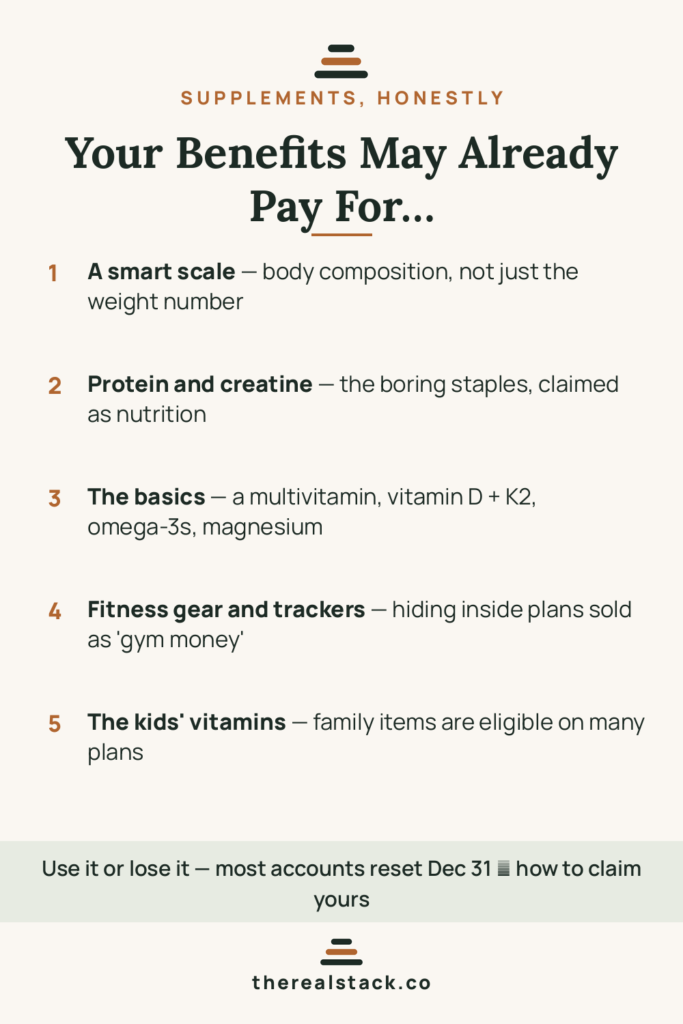
1. A smart scale — the most important purchase on this list
The first thing I bought with wellness money was a proper smart scale (I use a Withings; there are good options at several price points). Not for the weight number — for the body composition reading.
When you’re losing weight on purpose, the scale alone can’t tell you the one thing you most need to know: am I losing fat, or am I losing muscle? In your early 40s, muscle is the asset I’m actually trying to protect. It’s what keeps you strong, mobile, and metabolically healthy into your 60s and beyond. A deficit that eats muscle is a bad trade, even if the number on the scale looks great.
So I track the trend: weight down, body-fat percentage down, lean mass holding. If lean mass starts sliding, that’s my signal to eat a little more or push protein higher — long before it becomes a problem. One device, bought once, claimed once, and it steers the whole project for years. If your plan covers health-tracking devices, this is where I’d spend first.
2. Protein powder and creatine — the unglamorous staples
The two supplements with real evidence behind them are also the two most boring: protein and creatine. I buy both in bulk — big tubs of protein powder (plant-based, in my case) and plain creatine monohydrate — and claim them as nutrition expenses.
Creatine is a few dollars a month and is one of the most studied supplements in existence. Protein powder is just food in a convenient form, but it’s the difference between hitting my protein target on a busy workday and not hitting it. Neither will ever trend on social media the way a peptide does. Both actually work.
3. The supporting cast
The rest of my shelf is short and deliberate: a multivitamin, vitamin D with K2 (a non-negotiable in a Canadian winter), omega-3s, and magnesium in the evening. Nothing exotic, nothing with a proprietary blend and a celebrity attached. If a plan covers supplements, a year’s supply of the basics costs less than most people expect — especially bought on sale.
4. Vitamins for the kids
Depending on the plan, family health items can be eligible too — I’ve claimed vitamins for my kids (4 and 2). It’s a small thing, but it’s the same principle: money allocated to my family’s health, already mine, that I used to leave on the table.
How to actually do this
- Find the account. Log into your benefits portal and look for “wellness,” “personal spending,” or “lifestyle” account. Note the balance and — critically — the reset date.
- Read the eligible list, not the brochure. The detailed expense list is where the surprises are. Equipment and supplements hide in plans that advertise themselves as “gym money.”
- Buy durable first. A scale lasts a decade; a tub of protein lasts a month. If your balance is limited, spend it on the things you’d otherwise never buy.
- Stack it with sales. Wellness dollars go further on Black Friday or Prime Day pricing. The claim doesn’t care that you bought it on sale.
- Keep receipts and submit promptly. Take a photo of every receipt the day you buy. Claims are painless when the paperwork is already in your camera roll.
- Don’t buy things you don’t need just to spend it. The benefit being “free” doesn’t make a useless gadget useful. Everything on my list is something I was already using or had already decided to buy.
The point
The longevity world runs on expensive signals — clinics, infusions, compounds you have to source from a grey-market website and inject on a schedule someone on a forum invented. Almost none of that is where the returns are.
The returns are in the boring stack: sleep, training, protein, creatine, and measurement — knowing whether what you’re doing is actually working. And there’s a reasonable chance your employer is already offering to pay for a good chunk of it, in an account that resets at the end of the year whether you use it or not.
Go check your balance.
This is not financial or medical advice; benefit eligibility varies by employer and plan, so confirm yours before purchasing. Read our Disclaimer & Disclosure.
This article reflects personal experience and general education; it is not medical advice, and it isn’t benefits or tax advice either — wellness coverage varies by plan and employer, so confirm yours before purchasing. See our Disclaimer & Disclosure page.
Leave a Reply