Author: The Real Stack

  • Longevity Bloodwork in Ontario: What OHIP Already Pays For

    Longevity Bloodwork in Ontario: What OHIP Already Pays For

    If you read my supplement article, you saw the rule I run my whole routine by: one trial at a time, four to eight weeks, bloodwork before and after. This article is the bloodwork half of that system — what I test, why, and the part that surprised me most when I looked into it:

    In Ontario, almost the entire core longevity panel is already paid for by OHIP — as long as a clinician orders it. The expensive part of “longevity testing” in Canada usually isn’t the tests. It’s the membership wrapped around them.

    I’m in my early 40s, I lost about 35 pounds in the last few months, and I take a small stack of supplements (the honest grading is in the stack article). Bloodwork is how I check that the whole project is actually working — and how I catch the things a bathroom scale can’t see. Here’s the panel, what it costs, and how to get it.

    Not medical advice — just one person’s experience plus the published evidence and Ontario’s actual coverage rules. Bloodwork needs a clinician to order it and interpret it in context. If something comes back flagged, that’s a conversation for your doctor, not a search engine.
    Ontario bloodwork: what OHIP covers

    Why bloodwork at all

    Weight, sleep scores, and how your clothes fit are real signals, but they’re lagging and incomplete. A basic panel tells you, early and cheaply:

    • Metabolic health — are you drifting toward insulin resistance while your weight looks fine?
    • Cardiovascular risk — the markers that predict heart disease decades out, not next year.
    • Liver and kidney function — the quiet organs that supplements, alcohol, and hard training all pass through.
    • Hormones and micronutrients — thyroid, testosterone, iron, B12, vitamin D: the stuff that explains “I feel off” when everything else looks normal.

    The point isn’t a 100-marker fishing expedition. It’s a short list of markers with strong evidence behind them, measured consistently, so you can see trends. One reading is a snapshot; the same panel every 6–12 months is a story.

    The core panel — and what OHIP covers

    Here’s the panel I work from, with Ontario coverage as of late 2026. The headline: since April 1, 2026, Ontario’s insured lab schedule includes ApoB and Lp(a) when ordered per Canadian Cardiovascular Society guidance — which means the two most useful modern cardiovascular markers joined the already-insured basics.

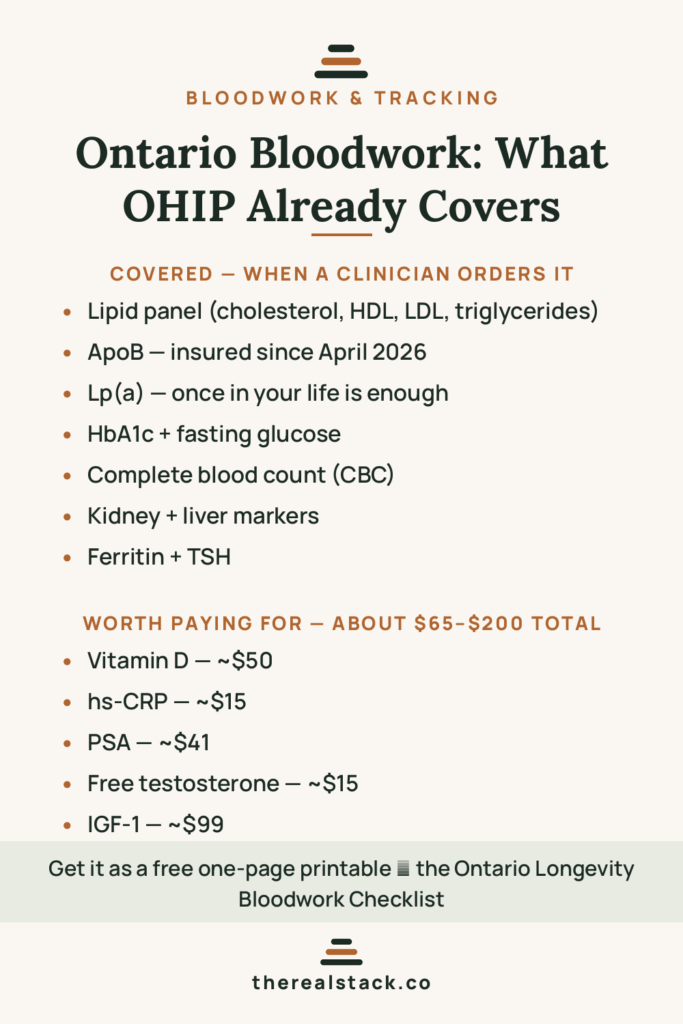
    Insured when a clinician orders them (no charge at the lab):

    • Lipid panel — total cholesterol, HDL, LDL, triglycerides
    • ApoB — arguably a better measure of atherogenic particle count than LDL alone; insured since April 2026
    • Lp(a) — a largely genetic cardiovascular risk factor you only need to measure once in your life; insured since April 2026
    • HbA1c and fasting glucose — average blood sugar over ~3 months, plus the fasting snapshot
    • Complete blood count (CBC)
    • Creatinine (kidney), ALT (liver), albumin, alkaline phosphatase
    • Ferritin (iron stores) and TSH (thyroid) — insured, typically ordered when there’s a reason

    The handful you pay for yourself:

    • Vitamin D (25-hydroxy) — Ontario delisted routine vitamin D testing back in December 2010. OHIP covers it only with osteoporosis, osteopenia, rickets, malabsorption, kidney disease, or medications that affect vitamin D metabolism. Otherwise it’s about $50 at Dynacare or $78 at LifeLabs. I supplement D3 daily, which is exactly why I want the number rather than guessing.
    • hs-CRP — the high-sensitivity inflammation marker. Ontario’s schedule lists regular CRP, not the high-sensitivity version, so this one is patient-pay: roughly $15 at Dynacare. Cheap, and one of the more useful “is something brewing” signals.
    • PSA (prostate) — OHIP covers it with a diagnosis or clinical suspicion, not for routine screening. Private-pay it’s about $41 at Dynacare. The screening guidelines here are genuinely debated, so whether it belongs on your list is a conversation to have with your doctor, weighing your own history and risk factors.
    • Free testosterone — not OHIP-covered; about $15 at Dynacare. (Total testosterone ordered for a clinical reason is a different story — ask your clinician.)
    • IGF-1 — the growth-hormone-axis marker that comes up in every peptide conversation, which is why it’s on my baseline list: if you’re going to read about compounds that claim to move this axis, knowing your own number is the honest starting point. Patient-pay, roughly $99 at LifeLabs (prices move; confirm before the draw).
    • Fasting insulin — the grey one. Some Ontario price lists show it as patient-pay around $27; other sources describe it as insured. The lab will tell you before your sample is taken, which is the right moment to decide.

    Add it up and the uninsured extras on a serious panel run roughly $65–$200, depending on how many of them you include. That’s the whole “longevity testing” bill if a clinician writes the requisition.

    How to actually get it

    Option 1: Your family doctor. The cheapest route by far. Bring the list, explain you want a preventive baseline, and the insured tests cost you nothing at the lab. The constraint is real, though: not every doctor will order a preventive panel for a healthy-feeling person in their early 40s, and appointment time is scarce. Worth asking — many will, especially with a family history to point at.

    Option 2: A telehealth requisition. If you don’t have a family doctor, or yours won’t order it, virtual clinics will review your intake and write the requisition — one Ontario service charges about $49 per consultation, and the insured tests are then billed to OHIP at $0 to you at the lab. You pay the consult fee plus any uninsured extras.

    Option 3: A longevity membership. Services like NiaHealth charge around $699 a year for a large panel, clinician review, and the convenience of having it all arranged. I’m not knocking it — if it gets someone tested who otherwise wouldn’t, it has value. But understand what you’re buying: mostly ordering, interpretation, and hand-holding. The underlying tests are largely the same ones OHIP already pays for when a clinician orders them, drawn at the same Dynacare and LifeLabs locations.

    The trap: direct-to-consumer lab stores. LifeLabs and others sell test kits directly online. Convenient — but those orders bypass provincial insurance entirely, so you pay 100% out of pocket even for tests that would have been free on a clinician’s requisition. Fine for a one-off; an expensive habit as a system.

    Two practical notes: the lab will tell you the cost of any uninsured test before your sample is taken, so there are no surprise bills if you ask. And if you have extended health benefits or a health spending account, uninsured lab work is often claimable — worth checking before you assume it’s all on you.

    What I’m actually doing

    Full honesty, per this site’s whole premise: I have not done this panel yet. Here’s the plan I’m running, and I’ll report back when I have numbers:

    1. Baseline panel via a telehealth visit: the insured core above, plus PSA, testosterone, a full thyroid panel, the metabolic markers, and IGF-1.
    2. 90-day recheck at Dynacare or LifeLabs, same lab, morning, fasted — so the comparison is clean.
    3. Bloodwork brackets every supplement trial. The stack article’s rule — one trial at a time, 4–8 weeks — only means something if there’s a before and an after. The panel is the before.

    One more thing that belongs in the same conversation: bloodwork doesn’t substitute for the screenings your age and history call for. It complements them.

    How to read your results without spiralling

    • Trends beat snapshots. A single borderline number is information, not a verdict. The same marker moving the same direction across three panels is a pattern worth acting on.
    • Reference ranges are population ranges. “Normal” means “common,” not necessarily “optimal” — but chasing internet-optimal values for 40 markers is its own trap. Pick the handful with real evidence and watch those.
    • Same conditions every time. Same lab, morning draw, fasted if the test requires it, no brutal workout the day before (it moves several markers). Consistency is what makes the trend readable.
    • A clinician reads it with you. Especially anything flagged. The panel is a tool for a conversation, not a self-diagnosis kit.

    The bottom line

    You don’t need a $699 membership to know your ApoB. In Ontario, the core longevity panel — lipids, ApoB, Lp(a) once, HbA1c, CBC, kidney and liver markers — is OHIP-insured when a clinician orders it. The extras worth paying for (vitamin D, hs-CRP, and whatever your family history argues for) run tens of dollars, not hundreds.

    Get the baseline. Repeat it on a schedule. Let the trends, not the marketing, tell you what to do next.


    Sources: Ontario Schedule of Benefits for Laboratory Services (coverage as described by Ontario lab price guides, updated 2026); Canadian Cardiovascular Society guidance on ApoB and Lp(a) (Ontario insured since April 1, 2026); Dynacare and LifeLabs Ontario patient-pay price listings (vitamin D $50/$78, hs-CRP ~$15, PSA ~$41, free testosterone ~$15, IGF-1 ~$99 — prices read November 2026, confirm before your draw); Ontario’s December 2010 delisting of routine vitamin D testing. Telehealth requisition pricing (~$49/consult) and membership pricing (~$699/yr) from the providers’ published rates, November 2026. Not medical advice.

    Want this as a one-page printable? Get the free Ontario Longevity Bloodwork Checklist here.
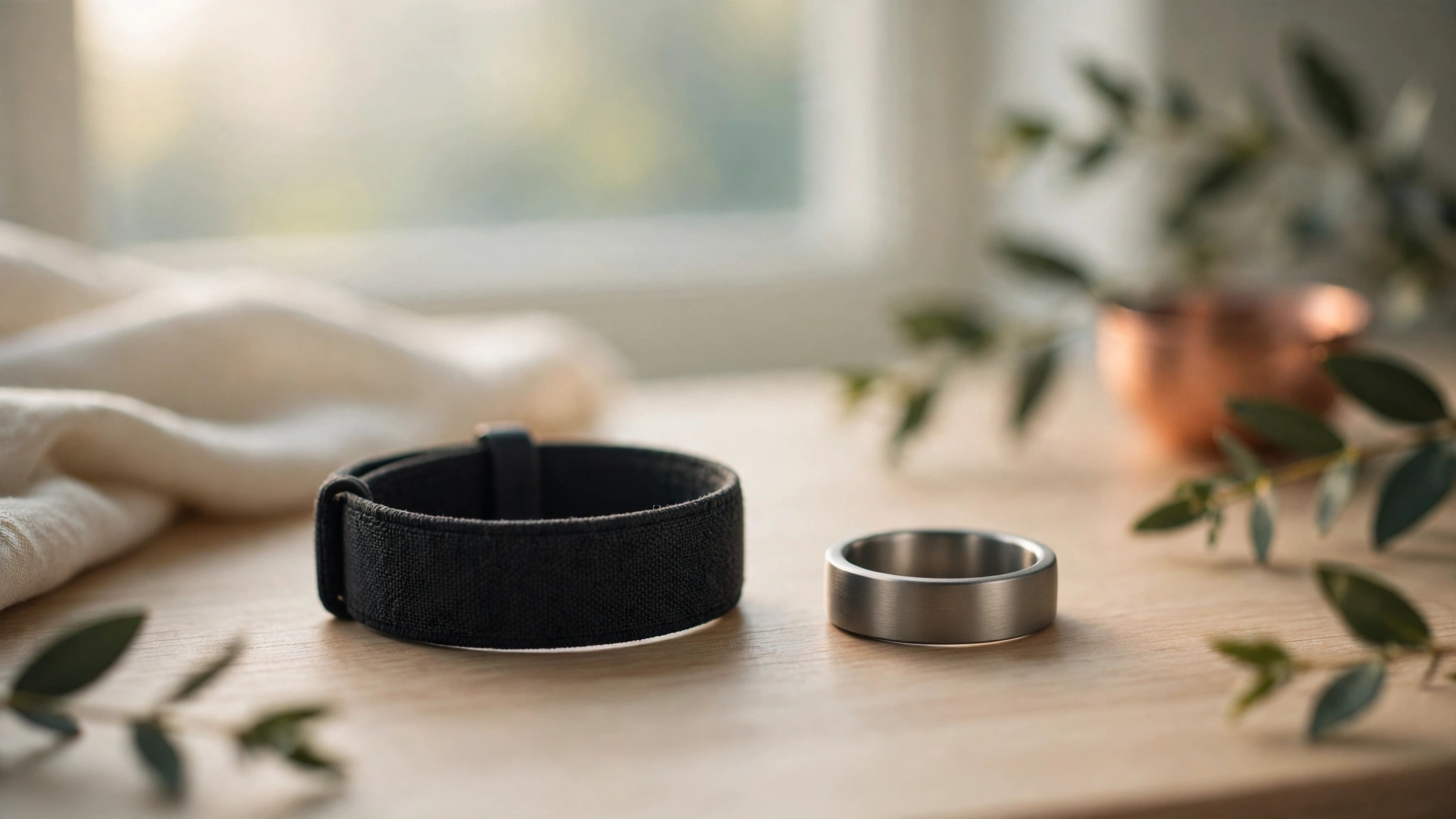
  • Whoop vs Oura: Why I Wear the Band (and Who Should Buy the Ring)

    Whoop vs Oura: Why I Wear the Band (and Who Should Buy the Ring)

    Disclosure: this article contains affiliate links, including my Whoop referral link. If you buy through them, I may earn a commission at no extra cost to you.

    Full disclosure before anything else, because this site runs on it: I wear a Whoop every day. I have never worn an Oura Ring. I researched the ring hard before choosing — including the Ring 5 that launched in May 2026 — and I stayed with the band. This article is why, what I gave up by choosing it, and the kind of person who should make the opposite call.

    If you’re deciding between these two, the spec sheets won’t settle it. Both track sleep, heart rate variability, resting heart rate, and recovery-style scores. Both are screenless. Both want a subscription. The real differences are form factor, total cost over years, battery life, and what each one is actually optimizing for — training load, or sleep and readiness.

    Not medical advice, and neither device is a medical device. This is one person’s experience plus published specs and validation research. Prices are Canadian where I could verify them, checked November 2026 — confirm before you buy, because both companies adjust pricing.

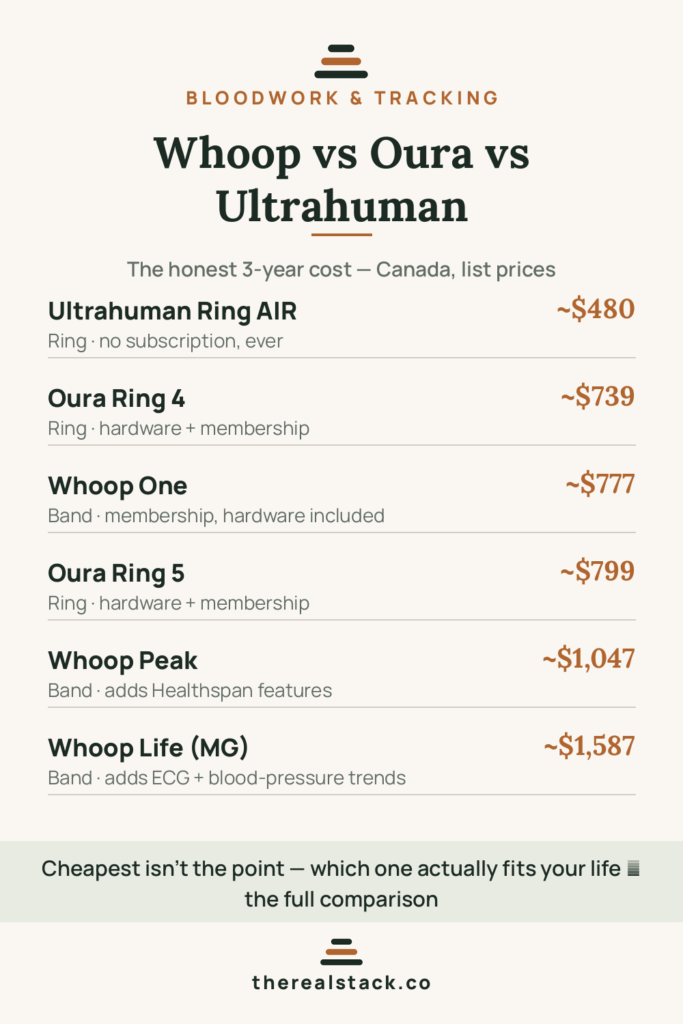
    Whoop vs Oura vs Ultrahuman: the real three-year cost in Canada

    The two products, as they stand in late 2026

    Whoop 5.0 (and the medical-grade MG). A screenless fabric band you wear on your wrist around the clock. Whoop doesn’t sell hardware — you buy a membership and the band comes with it:

    • One — CA$259/year: Whoop 5.0, basic wired charger, core recovery/strain/sleep tracking
    • Peak — CA$349/year: adds the wireless PowerPack (charges on your wrist) and the Healthspan, Health Monitor, and stress features
    • Life — CA$529/year: the Whoop MG, which adds ECG and blood-pressure trend insights (the ECG and irregular-rhythm notifications are Health Canada licensed)

    Battery is rated at 14+ days. Stop paying and the band stops working — the membership is the product.

    Oura Ring 5 (and the Ring 4). A titanium ring, a few grams, that reads as jewelry. You buy the hardware, then pay for the app:

    • Ring 5 — from CA$529 (premium finishes CA$649): 40% smaller than the Ring 4, battery rated 6–9 days
    • Ring 4 — from CA$469: still sold, same app and same scores, battery 5–8 days
    • Membership — CA$7.99/month or CA$89.99/year after a free first month; without it, the ring’s detailed scores and trends are locked

    The third option: Ultrahuman Ring AIR. A newer, smaller player worth knowing about, because it breaks the pattern above: no subscription at all. The ring lists at CA$479.99 at Best Buy Canada (it’s discounted often — check before paying list), and the app’s core features are included for life. Titanium, about 2.4 g at the smallest sizes, battery rated up to 6 days. It tracks the same core signals — sleep, HRV, resting heart rate, skin temperature — and builds its own recovery and strain-style scores around them. The trade-offs: a younger, smaller company, a thinner evidence base than Oura’s, and an app that’s still maturing. I haven’t worn this one either — it arrived into a decision I’d already made — but if the subscription model is your main objection to both devices above, this is the one that answers it.

    The honest 3-year math (Canada)

    Sticker prices lie; three-year totals don’t:

    Up front3 years of fees3-year total
    Ultrahuman Ring AIRCA$479.99CA$0~CA$480
    Oura Ring 4CA$4693 × CA$89.99~CA$739
    Whoop OneCA$03 × CA$259~CA$777
    Oura Ring 5CA$5293 × CA$89.99~CA$799
    Whoop PeakCA$03 × CA$349~CA$1,047
    Whoop Life (MG)CA$03 × CA$529~CA$1,587

    Two things jump out. First, the Ultrahuman is now the cheapest way into this category over three years — one payment, no fees — with the Ring 4 next, still cheaper than Whoop’s entry tier. Second, the gap between “entry Whoop” and “entry Oura” is small enough that cost alone shouldn’t decide it. The tier you actually want matters more: the moment you want Whoop’s Healthspan features or the MG’s ECG, you’re paying meaningfully more than either ring.

    Where Whoop wins (for me)

    Training is the point. I train with dumbbells at home four days a week, 20–30 minutes a session. Whoop is built around strain — how hard today was, and whether tomorrow should be hard too. That framing matches how I actually make decisions: push, or back off. Oura’s Readiness score answers a similar question, but Whoop’s whole app is organized around training load in a way the ring’s isn’t.

    A ring and dumbbells don’t mix. This one is practical, not theoretical. Gripping dumbbells with a titanium ring on your finger is uncomfortable at best and a pinch risk at worst — lifters generally take rings off to train. A band on the wrist (or bicep) just stays on. For someone whose training is the reason they track at all, that’s close to decisive.

    Battery I can forget about. 14+ days, and on Peak it charges on my wrist while I wear it. With two kids under five, “remember to charge the tracker” is a chore that loses. The ring’s 6–9 days is fine — it’s just one more thing on the list.

    Sleep tracking without a screen. Both devices are screenless, which I consider a feature. My sleep routine (the full article is on this site) depends on the bedroom being boring. A band that never buzzes or glows fits that; so does the ring, honestly. Tie.

    Where Oura wins (and what I gave up)

    It’s invisible. A ring disappears into a workday, a suit, a wedding photo. A fabric band on your wrist reads “fitness person” in every meeting. If discretion matters — client-facing work, formal settings — the ring wins and it isn’t close.

    The sleep and HRV research is stronger. Oura’s overnight HRV has independent validation behind it (including an Air Force Research Laboratory–funded study in 2025 where the Ring 4 was the closest of five devices to reference measurements). Whoop 4.0’s overnight HRV showed moderate agreement with ECG in a 2025 study, and there’s no independent published validation of the 5.0 yet. If your primary use is overnight physiology — sleep quality, temperature trends, cycle tracking — Oura has the deeper evidence base.

    Temperature trends. Oura’s skin-temperature deviation tracking is genuinely useful for spotting illness coming on and for cycle insights. Whoop tracks skin temperature too, but it’s not the headline feature it is on the ring.

    You own something at the end. Cancel Whoop and you own a paperweight. Cancel Oura and you still own a ring (with a much dumber app). Over a decade, that ownership difference compounds.

    Cycle and women’s health features. Not my use case, but if you’re buying for a partner or comparing for a household, Oura’s cycle insights are a real differentiator Whoop doesn’t match.

    The accuracy question, honestly

    Both devices are good at the things optical sensors are good at: resting heart rate, sleep/wake detection, and overnight HRV trends. Both are weaker at the things optical sensors are bad at: precise sleep-stage breakdowns (light/deep/REM percentages are estimates, not measurements — true staging needs a sleep lab) and heart rate during hard intervals.

    The practical takeaway: trust the trends, distrust the single-night score. A week of declining HRV and rising resting heart rate means something. One red recovery morning after a late, salty dinner mostly means you had a late, salty dinner. Whichever device you buy, that rule will save you from more bad decisions than the hardware choice will.

    Who should buy which

    Buy the Whoop if: training drives your decisions; you lift (especially with anything you’d grip); you want strain/recovery coaching; you’d rather pay yearly all-in than buy hardware; two-week battery matters. If you go with Whoop, here’s my Whoop referral link — it gets you a free month, and it’s the one I’d send a friend.

    Buy the Oura if: sleep and readiness are the point; you want something invisible at work; temperature trends or cycle tracking matter; you prefer owning hardware; the Ring 4’s 3-year cost (~CA$739) is the budget-friendly entry.

    Buy the Ultrahuman if: the subscription is the deal-breaker; you want the ring form factor at the lowest 3-year cost (~CA$480, all-in); you’re comfortable trading a deep evidence base for a simpler deal.

    Buy neither if: you won’t wear it every night for months. Both devices earn their keep through consistent data — baselines take weeks to establish. A tracker in a drawer has an accuracy of exactly zero, and the subscription still bills you.

    My bottom line

    I stayed with Whoop because I train with dumbbells four days a week and the strain/recovery loop is how I decide what tomorrow looks like. The ring is the better sleep device on the evidence, the better-looking device by a mile, and — in Ring 4 form — the cheaper one over three years. If my training ever stops being the center of my routine, I’d switch without much regret.

    That’s the honest version. Your call depends on which question you’re actually asking the device: “How hard can I train today?” (band) or “How did I sleep, and am I ready?” (ring).


    Sources: Whoop and Oura official product and membership pages (Canadian pricing checked October–November 2026: Whoop One CA$259/yr, Peak CA$349/yr, Life CA$529/yr; Oura Ring 5 from CA$529, Ring 4 from CA$469, membership CA$7.99/mo or CA$89.99/yr); Whoop 5.0/MG launch and tier structure (May 2025); Oura Ring 5 launch (May 28, 2026); overnight HRV validation research (AFRL-funded independent study, 2025; Whoop 4.0 vs ECG agreement study, 2025); Health Canada licensing of Whoop MG ECG features (April 2025). 3-year totals are simple list-price arithmetic before tax. Not medical advice; neither device is a medical device. Ultrahuman Ring AIR official product page and Best Buy Canada listing (CA$479.99 list, checked November 2026).

  • Someone Else Is Already Paying for Your Stack

    Someone Else Is Already Paying for Your Stack

    Disclosure: this article contains affiliate links, including a Webber Naturals referral link. If you buy through one, I may earn a commission at no extra cost to you.

    People assume a health routine like mine costs a fortune. The scale, the protein, the creatine, the shelf of supplements — it looks like a hobby with a monthly burn rate.

    Here’s the part nobody talks about: a large share of mine is paid for by my employer, through a benefit I ignored for years. If you have a salaried job in Canada, there’s a decent chance you have the same money sitting in an account with your name on it, expiring quietly at the end of the year.

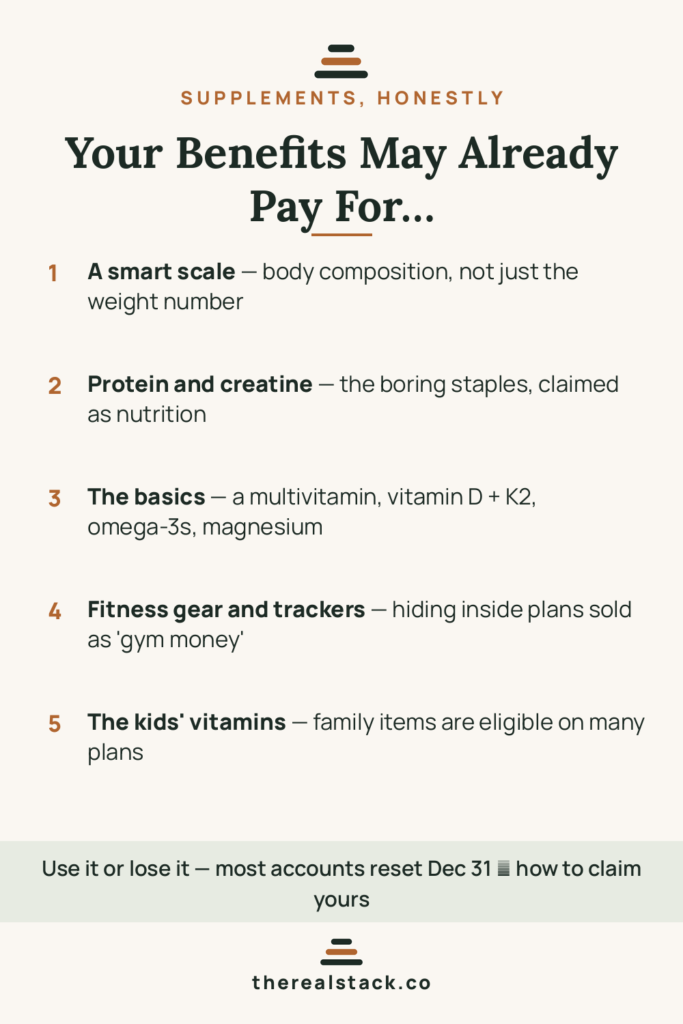
    Your benefits may already pay for your health stack

    The account most people never open

    Many employers offer a wellness spending account (sometimes called a personal spending account or lifestyle account) alongside regular health benefits. It’s a pot of money — often a few hundred to over a thousand dollars a year, depending on the employer — that you can claim against a list of eligible wellness expenses.

    Two things matter about it:

    1. It’s use-it-or-lose-it. Most of these accounts reset on a fixed date (for many plans, December 31) and unspent money doesn’t roll over. It just evaporates.
    2. The eligible list is broader than you think. Most people picture gym memberships. Depending on the plan, the list can also include fitness equipment, nutrition products, supplements, and health-tracking devices. Mine covers all of those.

    One honest caveat up front: in Canada, wellness account reimbursements are generally a taxable benefit — the money shows up as income. So it’s not entirely free. But paying tax on money you’d otherwise never see is still a trade you win every time. And eligibility varies a lot by employer, so everything below comes with the same instruction: read your own plan’s eligible-expense list before you buy anything.

    What I actually claim

    1. A smart scale — the most important purchase on this list

    The first thing I bought with wellness money was a proper smart scale (I use a Withings; there are good options at several price points). Not for the weight number — for the body composition reading.

    When you’re losing weight on purpose, the scale alone can’t tell you the one thing you most need to know: am I losing fat, or am I losing muscle? In your early 40s, muscle is the asset I’m actually trying to protect. It’s what keeps you strong, mobile, and metabolically healthy into your 60s and beyond. A deficit that eats muscle is a bad trade, even if the number on the scale looks great.

    So I track the trend: weight down, body-fat percentage down, lean mass holding. If lean mass starts sliding, that’s my signal to eat a little more or push protein higher — long before it becomes a problem. One device, bought once, claimed once, and it steers the whole project for years. If your plan covers health-tracking devices, this is where I’d spend first.

    2. Protein powder and creatine — the unglamorous staples

    The two supplements with real evidence behind them are also the two most boring: protein and creatine. I buy both in bulk — big tubs of protein powder (plant-based, in my case) and plain creatine monohydrate — and claim them as nutrition expenses.

    Creatine is a few dollars a month and is one of the most studied supplements in existence. Protein powder is just food in a convenient form, but it’s the difference between hitting my protein target on a busy workday and not hitting it. Neither will ever trend on social media the way a peptide does. Both actually work.

    3. The supporting cast

    The rest of my shelf is short and deliberate: a multivitamin, vitamin D with K2 (a non-negotiable in a Canadian winter), omega-3s, and magnesium in the evening. Nothing exotic, nothing with a proprietary blend and a celebrity attached. If a plan covers supplements, a year’s supply of the basics costs less than most people expect — especially bought on sale.

    4. Vitamins for the kids

    Depending on the plan, family health items can be eligible too — I’ve claimed vitamins for my kids (4 and 2). It’s a small thing, but it’s the same principle: money allocated to my family’s health, already mine, that I used to leave on the table.

    How to actually do this

    1. Find the account. Log into your benefits portal and look for “wellness,” “personal spending,” or “lifestyle” account. Note the balance and — critically — the reset date.
    2. Read the eligible list, not the brochure. The detailed expense list is where the surprises are. Equipment and supplements hide in plans that advertise themselves as “gym money.”
    3. Buy durable first. A scale lasts a decade; a tub of protein lasts a month. If your balance is limited, spend it on the things you’d otherwise never buy.
    4. Stack it with sales. Wellness dollars go further on Black Friday or Prime Day pricing. The claim doesn’t care that you bought it on sale.
    5. Keep receipts and submit promptly. Take a photo of every receipt the day you buy. Claims are painless when the paperwork is already in your camera roll.
    6. Don’t buy things you don’t need just to spend it. The benefit being “free” doesn’t make a useless gadget useful. Everything on my list is something I was already using or had already decided to buy.

    The point

    The longevity world runs on expensive signals — clinics, infusions, compounds you have to source from a grey-market website and inject on a schedule someone on a forum invented. Almost none of that is where the returns are.

    The returns are in the boring stack: sleep, training, protein, creatine, and measurement — knowing whether what you’re doing is actually working. And there’s a reasonable chance your employer is already offering to pay for a good chunk of it, in an account that resets at the end of the year whether you use it or not.

    Go check your balance.

    This is not financial or medical advice; benefit eligibility varies by employer and plan, so confirm yours before purchasing. Read our Disclaimer & Disclosure.

    This article reflects personal experience and general education; it is not medical advice, and it isn’t benefits or tax advice either — wellness coverage varies by plan and employer, so confirm yours before purchasing. See our Disclaimer & Disclosure page.

  • Peptides in Canada: The Legal Reality (and Why “Research Use Only” Isn’t a Loophole)

    Peptides in Canada: The Legal Reality (and Why “Research Use Only” Isn’t a Loophole)

    If you’ve spent any time looking at peptides online, you’ve seen two things side by side: a website selling vials with human-use claims all over it, and a small label saying “research use only” or “not for human consumption.” Those two things can’t both be true — and in Canada, the law agrees with the label reader, not the marketer.

    This article is the plain-language version: what’s a prescription drug, what Health Canada has said and done, why the common loopholes aren’t loopholes, what you can get legally, and what to do if you’re genuinely curious.

    Education only, not legal advice and not medical advice. Rules change, and this is a snapshot of the law as it stands in late 2026 — if you’re making a decision, check Health Canada’s current guidance and talk to a clinician.

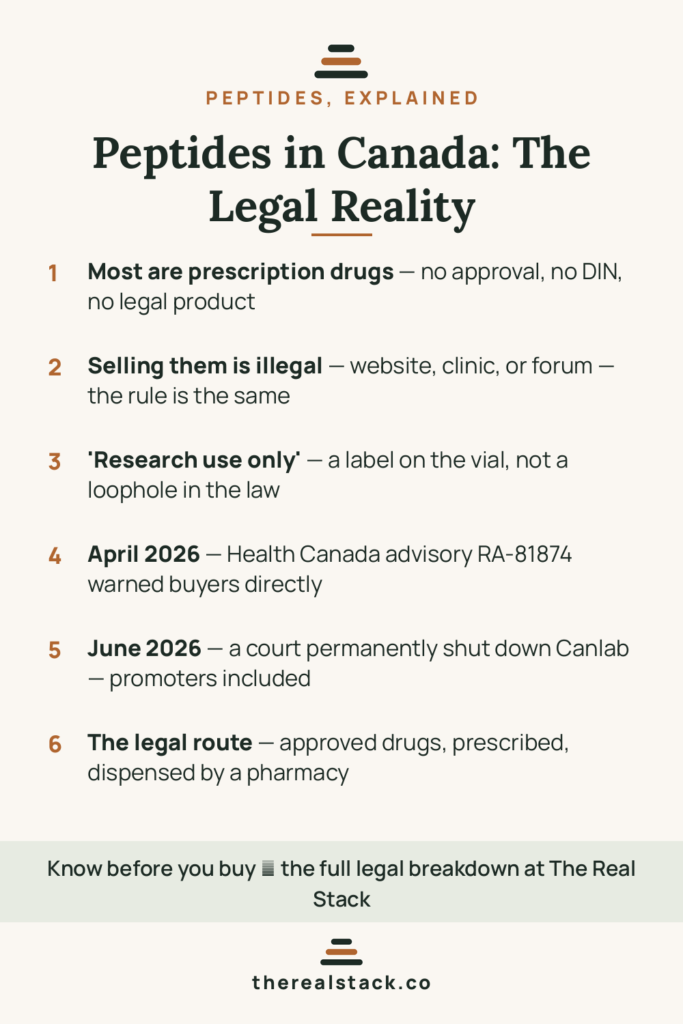
    Are peptides legal in Canada? The legal reality

    The starting point: most of these are prescription drugs

    In Canada, a drug’s legal status doesn’t depend on how it’s marketed online. It depends on what it is. Most of the peptides discussed in longevity and fitness circles — BPC-157, TB-500, GHK-Cu, CJC-1295, ipamorelin, MOTS-c, epithalon and others — are treated as prescription drugs under Canadian law. That means:

    • No product containing them has been approved by Health Canada. There is no Drug Identification Number (DIN) for them. A DIN is the basic marker of a legal drug product in Canada — without one, a product isn’t authorized for sale.
    • Selling them is illegal. Unauthorized products containing prescription drugs are not legal to sell in Canada, whether the seller is a website, a clinic, or a guy on a forum.
    • “But it’s just a peptide” doesn’t change anything. Peptides are drugs when they act like drugs. That some are short chains of amino acids, or that your body makes related molecules naturally, is legally irrelevant.

    The grey market isn’t a grey area — it’s an illegal market operating in the open, and the openness is the trick.

    What Health Canada has said — and done

    Health Canada hasn’t been vague about this. In an advisory dated April 9, 2026 (reference RA-81874), it warned Canadians about unauthorized peptide products — including BPC-157, TB-500, and similar compounds — sold online and in clinics, noting they are not authorized, their safety and quality are unverified, and they carry real risks. The advisory is the regulator speaking directly to consumers: these products are not approved, and buying them is buying blind.

    And it hasn’t stopped at warnings. On June 11, 2026, a court granted a permanent injunction against Canlab, a Canadian seller of unauthorized injectable peptides — and the injunction doesn’t just bar selling the products, it bars assisting others in advertising unauthorized injectable drugs. That reach is what matters: it covers the promoters, not just the seller.

    I mention these two specifically because they’re verifiable, dated, and public — not rumours. RA-81874 (April 2026) and the Canlab injunction (June 2026) are the two facts to keep in your pocket when someone tells you “everyone does it, so it must be fine.” Everyone does it, and the regulator has still said no — twice, in writing, with consequences.

    Why “research use only” isn’t a loophole

    This is the claim you’ll see most often, so let’s take it apart properly.

    The label “research use only” (or “not for human consumption”) is a seller’s attempt to reclassify a drug as a laboratory chemical. The argument, roughly, is: we’re not selling a drug for people, we’re selling a chemical for research, so the drug rules don’t apply. Health Canada has been explicit that this doesn’t work. Whether a product is a drug depends on what it is and how it’s presented — and when a website sells a vial with human-use claims one scroll away from a “research use only” disclaimer, the presentation gives the game away.

    If a label could exempt a product from drug law, every unauthorized drug in the country would carry one. The label is a fig leaf — and the fact that a seller needs one tells you they know exactly what they’re selling.

    The same logic applies to the other evasions you’ll see: selling it as a “cosmetic” or “supplement,” shipping from a warehouse in another country, or routing payment through a processor that doesn’t ask questions. None of these change the product’s legal status in Canada. They change how hard it is to catch the seller — which is a different thing, and not your protection.

    The advertising rule most promoters don’t know they’re breaking

    Here’s the part that surprises people, including a lot of content creators: in Canada, consumer advertising of prescription drugs is heavily restricted. For a prescription drug, the law allows advertising to the public of name, price, and quantity only — no claims about what it does, no benefits, no testimonials, no before-and-after stories.

    Health Canada treats anyone who promotes a specific product’s sale as advertising it — including affiliate content. A post that links to a peptide vendor with a discount code isn’t “just sharing information”; it’s advertising a prescription drug to the public, with claims attached, which the law doesn’t allow. The Canlab injunction’s reach into assisting others to advertise is the enforcement version of exactly this point.

    That’s why this site’s rule is absolute: peptide content here carries no product links, no vendor names, no discount codes, and no promotion of any kind. It’s not caution for its own sake — it’s the law, and the regulator has already shown it will enforce it.

    What you CAN get legally in Canada

    The legal picture isn’t “no peptides, ever” — it’s “approved peptides, through proper channels”:

    • Approved peptide drugs, prescribed by a clinician and dispensed by a licensed pharmacy. The clearest example is the GLP-1 class — drugs like semaglutide — approved in Canada with DINs, prescribed for specific indications, and dispensed through regulated pharmacies. If a peptide has a DIN, a prescription, and a pharmacy, it’s in the legal system.
    • Compounding — done properly. A licensed pharmacy can prepare a compounded medication for an individual patient, on a valid prescription, when a commercial product isn’t suitable. That’s a real, legal route — and it is not what grey-market vials are. A compounded prescription is made for one named patient, by a regulated pharmacy, under a clinician’s care. A vial bought from a website is none of those things. The difference is accountability, quality control, and a clinician who knows your history.
    • What a legitimate clinician will and won’t do. A doctor can discuss peptides, order relevant bloodwork, and prescribe approved drugs where they’re indicated. A doctor cannot legally prescribe BPC-157 or TB-500 — there’s no approved product to prescribe. If a clinic offers you those compounds, it’s selling an unauthorized product, whatever the white coat suggests.

    What happens if you buy anyway

    The practical consequences, which the sellers won’t tell you:

    • No regulator to complain to. If the product is contaminated, mislabelled, or harms you, there is no recall system and no regulator who can make it right. Regulated drugs come with a safety net. Grey-market products come with a “good luck.”
    • Product quality is unknowable. Independent analyses of unregulated online health products routinely find under-dosed, over-dosed, contaminated, or mislabelled products. Peptides are fragile molecules — heat and poor storage degrade them — and an anonymous vendor has no one checking any of it.
    • Payment and supply risk. Grey-market sellers operate outside normal payment processing, which is why they cycle through processors, crypto, and e-transfers. Orders get seized, vendors disappear, and refunds are a rumour. Several large peptide vendors shut down in 2026 alone.
    • Legal exposure is mostly the seller’s. Enforcement in Canada has focused on sellers and promoters, not individual buyers. That’s worth knowing honestly. But “unlikely to be prosecuted” is not the same as “legal,” and it’s a thin basis for putting an unverified injectable into your body.

    How to talk to a clinician about it

    If you’re genuinely curious, the productive move is a conversation with your own doctor, not a purchase:

    • Say what you’re interested in and why. “I’ve been reading about peptides for recovery — what does the evidence actually show?” is a good opening. A good clinician will have heard it before.
    • Bring the honest question, not the conclusion. The question isn’t “will you prescribe me BPC-157?” (they can’t). It’s “is there anything in my situation — sleep, hormones, iron, vitamin D, thyroid — that explains why my recovery is slow?” That’s a question with an answer, and often a fixable one.
    • Ask for the bloodwork. A routine panel — much of it OHIP-covered in Ontario when your doctor orders it — finds the deficiencies and metabolic problems that quietly sabotage recovery. It’s the boring, actionable version of what the peptide hype promises.
    • If a clinic offers you peptides, ask three questions: Is this product approved in Canada? Does it have a DIN? Who is the licensed pharmacy dispensing it? Evasive answers are your answer.

    The bottom line

    In Canada, the peptides that dominate the longevity conversation are prescription drugs with no approval, no DIN, and no legal route to sale. Health Canada said so in writing in April 2026 (advisory RA-81874) and a court backed it up with a permanent injunction in June 2026. “Research use only” is not a loophole, affiliate promotion counts as advertising, and the only legal peptides are approved ones prescribed by a clinician and dispensed by a licensed pharmacy.

    None of that means your underlying goal is wrong. Wanting to recover faster, heal better, and stay strong in your 40s is completely reasonable — it’s the same goal that built this site. It just means the legal, evidence-backed route to it isn’t a vial. It’s the unglamorous list this site keeps coming back to: sleep first (I wrote up the routine that changed everything for me here: Sleep: The Highest-Leverage Healthspan Habit Nobody Can Sell You), adequate protein, progressive training, routine bloodwork, and rest. All of it legal, all of it with human evidence behind it.

    Sources and further reading: Health Canada advisory RA-81874 (April 9, 2026) on unauthorized peptide products; the June 11, 2026 permanent injunction against Canlab; Health Canada guidance on the advertising of prescription drugs to consumers (Food and Drugs Act and Food and Drug Regulations, including the name/price/quantity restriction); the Prescription Drug List (Schedule F) and the Drug Identification Number system; Health Canada advisories on unauthorized peptide products sold online and in clinics.

    This article is education only — not legal advice and not medical advice. Rules change; check Health Canada’s current guidance and talk to your own clinician about any health decision. See our Disclaimer & Disclosure page.

  • TB-500: What the Human Evidence Actually Shows

    TB-500: What the Human Evidence Actually Shows

    If BPC-157 is the most searched peptide, TB-500 is its constant companion. Scroll any forum thread about healing, and you’ll find the pair sold as a stack: BPC-157 for this, TB-500 for that, together for faster recovery from everything. The pairing sounds scientific. It isn’t — it’s marketing that borrowed a real protein’s reputation and stapled it to a compound with almost no human data of its own.

    So let’s do the same thing we did with BPC-157: go through the evidence layer by layer, and separate what belongs to TB-500 from what belongs to something else entirely.

    Quick note: this is education, not medical advice, and this site never publishes doses, protocols, or sources for prescription or unapproved products. Short version: there are no completed human trials of TB-500, and in Canada it isn’t legal to sell. The long version is worth reading, because the confusion around this one is the whole story.

    TB-500 explained: what it is and what the evidence shows

    What TB-500 is

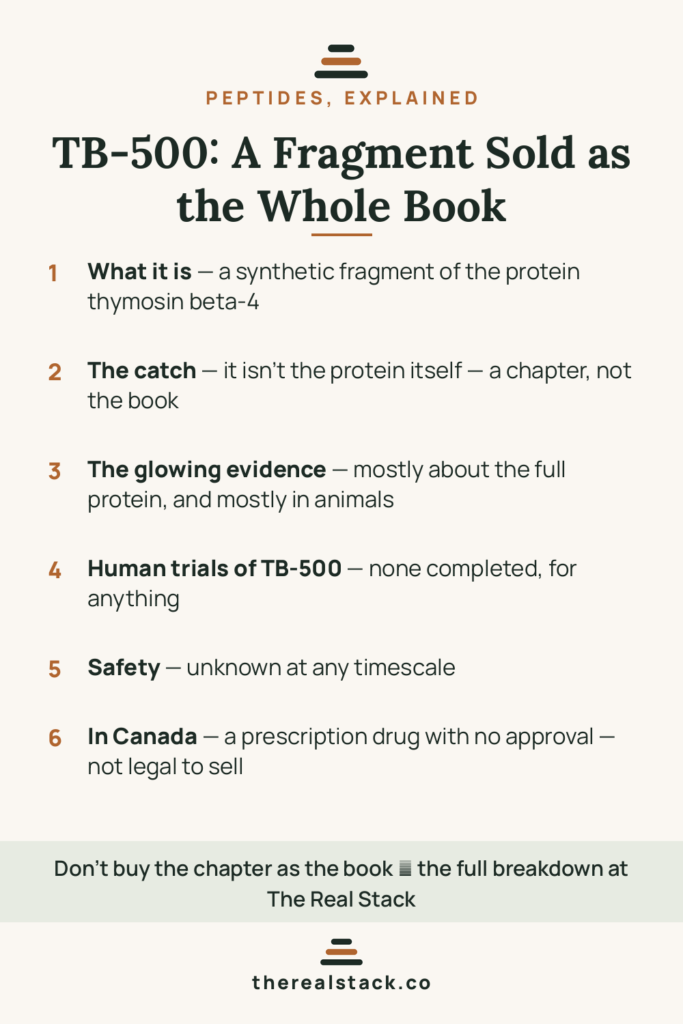
    TB-500 is a synthetic peptide — a short chain of amino acids — modelled on a fragment of thymosin beta-4, a protein your body makes naturally. Thymosin beta-4 is a 43-amino-acid protein found in nearly every cell, and its best-understood job is regulating actin, the scaffolding protein that lets cells move, change shape, and repair tissue. It’s involved in wound healing, blood-vessel formation, and the inflammatory response — which is exactly why researchers have been interested in it for decades.

    Here’s the distinction that matters, and that almost no seller will make for you: TB-500 is not thymosin beta-4. It’s a synthetic fragment derived from part of the thymosin beta-4 sequence. The two are related the way a single chapter is related to a whole book. Evidence about the full protein does not automatically transfer to the fragment, and evidence about the fragment in animals does not automatically transfer to people. Most of the confident claims you’ll read about TB-500 quietly slide between those three things — the protein, the fragment, and you — as if they were the same. They aren’t.

    The animal and cell data: interesting — about a different molecule

    Let’s be fair to the underlying science first, because thymosin beta-4 is genuinely interesting. In cell and animal studies, the full protein has shown effects on wound closure, corneal healing, cardiac repair after induced heart injury in animals, and blood-vessel growth. That’s a real research literature, built over decades, and it’s the reason the compound family keeps attracting attention.

    But notice what I just described: the full protein, mostly in animals and cells. The evidence for TB-500 itself — the synthetic fragment people actually buy — is a much thinner file, mostly animal and cell work of the same early-stage kind: faster wound closure in rodents, some tissue-repair signals. And even the thymosin beta-4 literature is preclinical at its core. Interesting, hypothesis-generating, and not evidence that a fragment of it heals injuries in a 40-something human.

    This is the pattern from the BPC-157 article, one step worse: with BPC-157, at least the animal data was about BPC-157. With TB-500, a large share of the impressive-sounding evidence is about a related but different molecule.

    The human data: essentially empty — for TB-500

    There are no completed, published, randomized controlled trials of TB-500 in humans. Not for tendons, not for muscle, not for recovery, not for anything.

    What human data exists belongs to other compounds, and you need to know the difference when you see it cited:

    • Thymosin beta-4 in eye drops. The full protein has been studied in humans as an eye drop formulation for dry eye and corneal wound healing, in small trials. That’s a different compound, a different route, a different condition — and even that work is early-stage, not an established treatment. If someone cites “human trials of thymosin beta-4” as proof TB-500 works for your shoulder, they’re doing the chapter-for-the-book trick.
    • Anecdotes and forum reports. The usual uncontrolled stories: someone recovered, someone didn’t, nobody measured anything, and the product itself was unverified. The weakest evidence there is.
    • Safety data: essentially absent. As with BPC-157, “no side effects reported in rat studies” is not a safety profile. A molecule involved in cell migration and blood-vessel growth raises theoretical questions — including about abnormal cell growth — that only human data can answer. There is none, for TB-500, at any timescale.

    So the honest summary, one line: a fragment of an interesting protein, with no human trials of its own and an unknown safety profile. The “healing stack” is two compounds with empty human files, sold together because the story sounds better in pairs.

    The legal situation in Canada

    Same as BPC-157, and for the same reasons. In Canada, TB-500 is treated as a prescription drug, and no product containing it has been approved by Health Canada — there is no Drug Identification Number (DIN) for it. Unauthorized TB-500 products are not legal to sell in Canada, and Health Canada has warned about and acted against unauthorized peptide products sold online and in clinics.

    The “research use only” label on the vial is the same fig leaf as before: Health Canada has been clear that this labelling doesn’t make an unauthorized drug product legal. And the same warning applies to the vendor’s logic — if the legal strategy is a wink, consider what that tells you about the quality strategy.

    The regulators and the grey market

    • The U.S. FDA has placed TB-500 among the bulk substances it considers to raise significant safety concerns with insufficient evidence — the same category BPC-157 sits in — meaning U.S. compounding pharmacies can’t legally use it.
    • The World Anti-Doping Agency bans it for athletes. If you compete in any tested sport, TB-500 is a disqualification waiting for a test, not a recovery aid.
    • The grey-market problem is identical to BPC-157’s, and just as basic: you don’t know what’s in the vial. Regulated drugs pass through manufacturing standards, batch testing, and a supply chain with accountability. Grey-market peptides pass through none of that. Independent analyses of unregulated online health products routinely find products that are under-dosed, over-dosed, contaminated, or contain something else entirely. Peptides are fragile molecules — heat and poor storage degrade them — and an anonymous online vendor has no regulator checking any of it. With TB-500 there’s an extra wrinkle: because the compound is defined by its relationship to thymosin beta-4, a buyer has even less ability to know whether what’s in the vial is TB-500, some other fragment, or nothing at all.

    The pivot: what actually heals

    The desire underneath the “healing stack” is completely reasonable — the same one behind BPC-157: you want to recover faster, heal nagging injuries, and not feel fragile in your 40s. It deserves interventions with human evidence behind them. Those exist, and they’re the same list, because the body heals the same way regardless of which vial you’re reading about:

    • Sleep. Tissue repair, growth-hormone release, and pain sensitivity are all strongly sleep-dependent. Chronic short sleep measurably impairs wound healing and athletic recovery in human studies. This was the first thing I fixed in my own life — consistent wake time, screens off before bed, sleep tracked with a wearable — and it did more for my recovery and training than any supplement I’ve ever taken. I went from ~240 lbs to ~205 now, training four days a week, and sleep was the foundation the rest was built on. I wrote up the full routine here: Sleep: The Highest-Leverage Healthspan Habit Nobody Can Sell You.
    • Protein and total nutrition. Healing is construction; it needs raw materials. Adequate protein intake is one of the best-supported levers in sports-medicine nutrition research.
    • Progressive, patient loading. Tendons and ligaments adapt to gradually increasing load — this is the basis of evidence-based rehab (the eccentric and heavy-slow-resistance protocols used in physiotherapy). It’s slow. It also works in humans, which is the entire point.
    • Bloodwork and the basics. Iron, vitamin D, thyroid, blood sugar — deficiencies and metabolic problems quietly sabotage recovery, and a routine blood panel (much of it OHIP-covered in Ontario when your doctor orders it) finds them. Boring. Actionable.
    • Not re-injuring it. Load management and actual rest — the advice nobody wants — remain the highest-yield “protocol” in sports medicine.

    None of that fits in a vial or ships in discreet packaging. All of it has the thing TB-500 doesn’t: evidence in people like you.

    The bottom line

    TB-500 is a synthetic fragment of an interesting protein, sold on the reputation of a molecule it isn’t, with no completed human trials of its own, an unknown safety profile, no legal status as a sellable product in Canada, a ban from WADA, and a grey market that can’t guarantee what’s in the bottle. Maybe rigorous trials will someday change that picture. If they do, this page will be updated — that’s what following the evidence means.

    Until then, the fastest legal way to heal and recover better is the unglamorous list above. Start with sleep. It worked for me, and unlike a research chemical, it comes with decades of human data.

    Sources and further reading: the preclinical literature on thymosin beta-4 in wound healing, corneal repair, and cardiac injury models in animals; published reports on thymosin beta-4 eye-drop formulations in small human studies for dry eye and corneal healing; U.S. FDA Pharmacy Compounding Advisory Committee materials and the 503A Category 2 bulk substances list; WADA Prohibited List; Health Canada advisories on unauthorized peptide products and the Food and Drug Regulations on prescription (Schedule F) drugs.

    This article is education only and is not medical advice. If you have an injury or a health concern, see your own clinician or physiotherapist. See our Disclaimer & Disclosure page.

  • Systems, Not Willpower: The Weekly Routines That Gave Me My Evenings (and My Health) Back

    Systems, Not Willpower: The Weekly Routines That Gave Me My Evenings (and My Health) Back

    A year ago, my weekdays ran me. I fell asleep on the commuter train — both directions — and snapped awake more than once close to missing my stop. I’d lie down to put my kids to bed and fall asleep beside them, and that was the end of my evening. I had no energy to play with my own children. At work I stress-ate and bought lunch out almost every day because deciding what to eat, let alone making it, felt like one thing too many. I described myself at the time as “just getting by,” and it was accurate.

    What changed was not motivation. Motivation had failed me reliably for about a decade. What changed is that I stopped relying on how I felt on any given day and built a small set of weekly routines that run almost on rails: a fixed wake time, a one-hour meal prep on Sundays, a fifteen-minute packing pass each night, and training slots that are treated like meetings. In the past three months I’m down about 35 pounds, my evenings are mine again, and the system has survived sick kids, work crunches, and bad weeks — because it was designed for them.

    This is the whole system, in the order I built it, so you can copy it.

    Not medical advice — this is one parent’s routine and the general evidence behind routines like it. Health conditions, injuries, and medications change what makes sense for you; that’s a conversation for your doctor.

    Why routines beat motivation

    Motivation is a weather report. It changes with sleep, stress, weather, and whatever your toddler did at 5 a.m. Routines are climate — they’re what your week looks like regardless of how Tuesday feels.

    The research on habit formation backs this up. A widely cited University College London study on how habits form found that repeating a behaviour in a consistent context made it progressively more automatic — but it took weeks to months, not days, and it varied a lot by person and behaviour. The implication matters: for the first stretch, a routine feels like effort because it is effort. The payoff comes when the behaviour stops requiring a decision. I don’t decide whether to pack lunches anymore, any more than I decide whether to brush my teeth. It’s just what happens at 7:30.

    That’s the real mechanism of everything below: remove decisions, attach each habit to a fixed time or an existing event, and make the default the healthy option. Willpower is then reserved for actual emergencies, which — with two young kids — arrive often enough on their own.

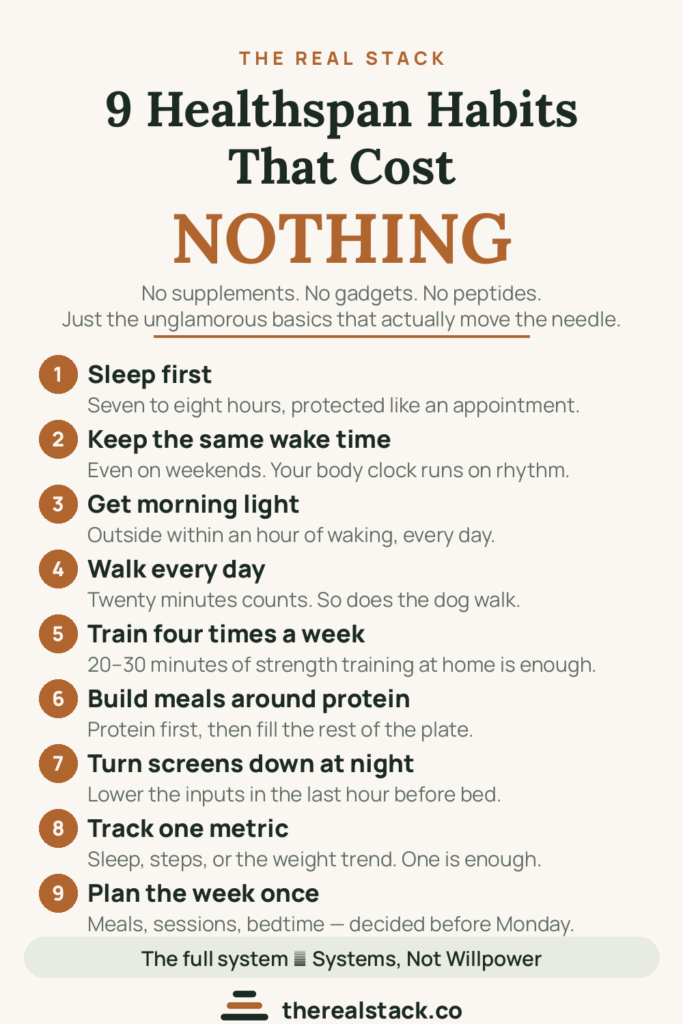
    9 healthspan habits that cost nothing — sleep first, same wake time, morning light, a daily walk, strength training four times a week, protein at every meal, screens down at night, track one metric, plan the week once (The Real Stack)

    The anchor: wake time

    Every routine in this article hangs off one: I get up at the same time every day, weekends included, within about half an hour.

    It sounds like a sleep tip. It’s actually the load-bearing wall of the whole system. A fixed wake time makes sleepiness arrive on schedule at night. It creates the early-morning slot where training can happen before the house wakes. It sets the rhythm that the evening packing pass and wind-down attach to. Large cohort research — including UK Biobank analyses of sleep regularity — associates consistent sleep and wake timing with lower mortality risk, independent of how long people sleep, which is a good reason to treat regularity as a health behaviour in its own right and not just a productivity trick.

    If you build nothing else from this article, build the anchor. (I wrote up the full sleep routine — screens off, wind-down, tracking — here: Sleep: The Highest-Leverage Healthspan Habit Nobody Can Sell You.)

    The Sunday prep: one hour, nine lunches

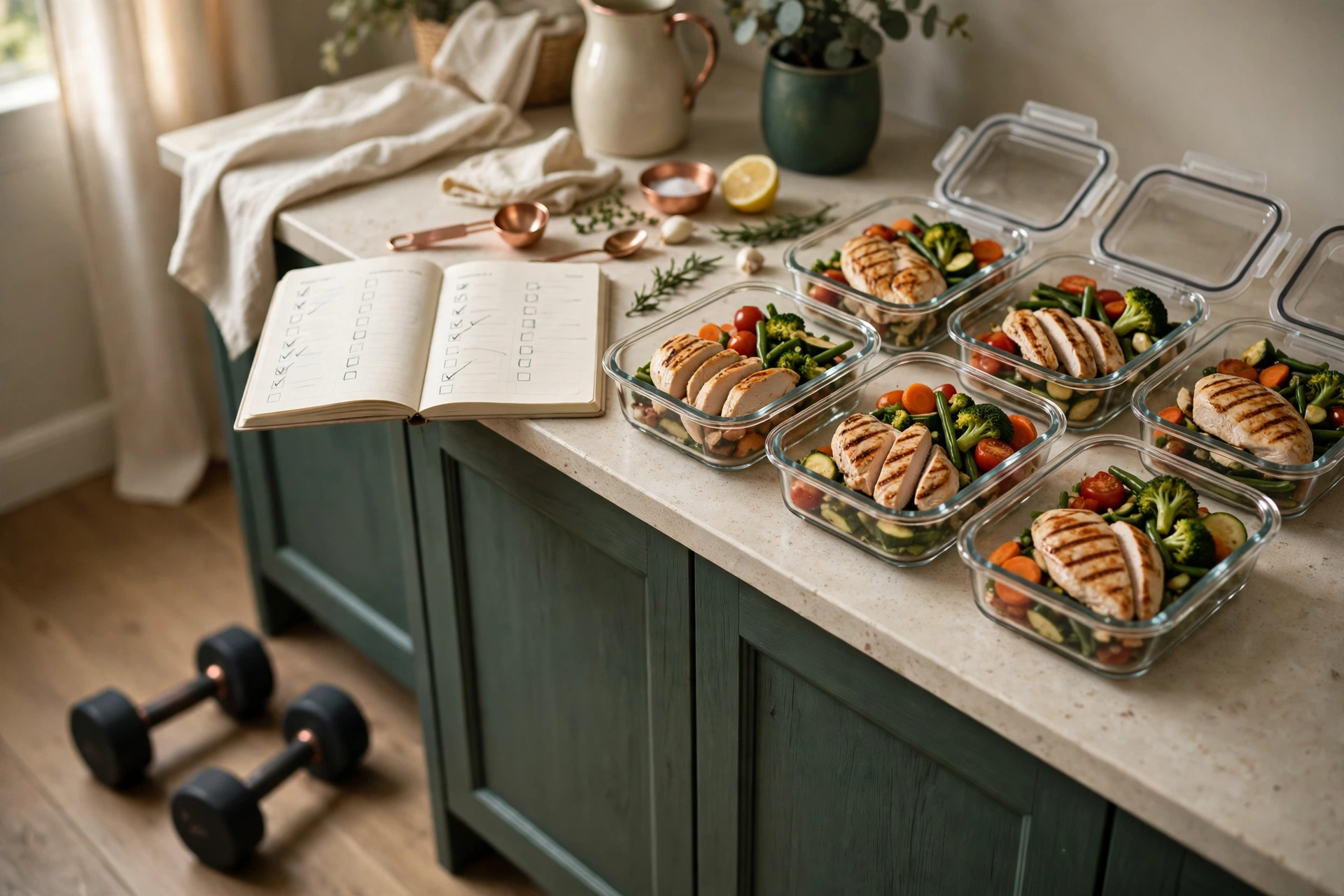
    This is the routine that killed the bought lunches, most of the stress eating, and a surprising amount of money. It is deliberately boring, because boring repeats.

    The formula never changes: one protein, one grain, one vegetable, one fruit.

    • Protein: chicken breast, cooked in one big batch — oven or grill, simply seasoned.
    • Grain: rice or quinoa, in the rice cooker, hands-off.
    • Vegetable: baby carrots — no cooking, no chopping, portioned straight into containers.
    • Fruit: apples, one per container.

    The output: about nine complete lunches — work lunches for my wife and me across the week. Nine containers, lids on, stacked in the fridge. Total active time is roughly an hour on a Sunday, most of it waiting for the oven and the rice cooker.

    The practical details that make it work:

    • Same shopping list every week. Chicken, rice or quinoa, baby carrots, apples. I can buy it half-asleep, and half the weeks, I do.
    • Containers you like. Uniform containers that stack and seal properly. It sounds trivial; a fridge full of mismatched lids is where meal prep goes to die.
    • Mind the fridge window. Standard food-safety guidance puts cooked meals at about three to four days in the fridge, so the late-week containers go in the freezer on Sunday and move to the fridge the night before they’re needed. Build that into the routine once and you never think about it again.
    • Good enough beats interesting. By Thursday the chicken-and-rice is not exciting. That’s fine. It’s fuel that removes a daily decision and a daily $15 problem. Variety lives at dinner.

    Observational research on home food preparation — including studies published in the International Journal of Behavioral Nutrition and Physical Activity — associates cooking and eating at home more often with better overall diet quality. I can’t promise you the mechanism from a study, but I can tell you the mechanism in my kitchen: when a decent lunch is already in the fridge with my name on it, the food truck stops being a temptation and starts being an errand I don’t need.

    The nightly pass: fifteen minutes at 7:30

    Every evening, after dinner, one pass through the kitchen — about fifteen minutes:

    1. Tomorrow’s lunch for me, moved to the front of the fridge, ready to go straight into my bag in the morning.
    2. Tomorrow’s lunch for my wife, same thing.
    3. My son’s school lunch, packed fresh the night before.

    Three lunches, one pass, done while the kitchen is already being tidied. This tiny routine does an outsized amount of work. It removes the morning scramble entirely. It removes the mid-morning “I forgot my lunch, I’ll just buy something” failure mode, which was previously my default setting. And because it’s attached to an event that always happens — dinner cleanup — it doesn’t need its own motivation.

    Training slots: protected like meetings

    I train with dumbbells at home, four times a week, in short sessions — before the house wakes up or after the kids are down, depending on the day. Three things make it stick:

    • It’s at home. No commute, no gym bag, no weather excuse. The dumbbells are ten steps away.
    • The slots are fixed. Same days, same rough times, treated like meetings I don’t reschedule for feelings. What gets protected gets done.
    • Short counts. A focused 30 minutes, done consistently for months, outperforms the heroic two-hour session I used to plan and skip. On genuinely wrecked days, the session shrinks — lighter, shorter — but it doesn’t disappear. (More on why that rule matters below.)
    • My wife is in it with me. When our schedules allow — and with two young kids, that’s some sessions, not all — we train together. It’s the accountability mechanism that actually works: a solo promise to yourself is easy to quietly renegotiate at 6 a.m., but when your partner is standing in the room expecting you, you show up. It also turns a chore into one of the few half-hours in our week that’s genuinely ours.

    The fallback: the dog walk counts

    Some days the workout just isn’t in me. The old version of me called those days zero days — all or nothing, and nothing won a lot. The system version has a floor instead: I take the dog out for a real walk. It’s movement, it’s daylight, and with a good podcast or some music in my ears it’s honestly something I look forward to — headspace, not a consolation prize. A walk is not a failed training day; it’s the minimum effective day, and keeping the minimum is what keeps the streak — and the habit — alive. This is the same rule as the collapse section below, applied to an ordinary tired Tuesday: shrink, don’t quit.

    The money, roughly

    I’ll label this clearly: this is my rough personal math, not a statistic.

    A bought lunch near work ran me roughly $15–20 — call it $300–400 a month — and that was before the stress-eating extras: the afternoon coffee run, the vending-machine or bakery stop on a bad day. A prepped lunch of chicken, rice or quinoa, carrots, and an apple costs a few dollars in ingredients — my rough estimate is $4–6 a meal. Across two adults eating prepped lunches through the work week, the system put a few hundred dollars a month back in our account. I did not expect a health habit to be one of the better financial decisions I made this year, but there it is.

    The one-page weekly template

    Copy this onto a note on your fridge. Adjust the times; keep the shape.

    Every day

    • Wake at ___ (same time, weekends too)
    • Screens off at ___ (phone down, screen time kept to a minimum)
    • 7:30 p.m. packing pass: my lunch, partner’s lunch, kid’s school lunch

    Sunday (≈1 hour)

    • Shop the standing list: protein, grain, vegetable, fruit
    • Cook the batch; portion ~9 containers; freeze the late-week ones
    • Glance at the week: confirm training slots around real life

    Training days (pick 4)

    • Session 1 ___ Session 2 ___ Session 3 ___ Session 4 ___

    Friday (5 minutes)

    • What worked? What slipped? Adjust one thing — only one.

    What makes it fall apart — and how to restart

    It does fall apart. A kid gets sick and the night goes sideways. Travel eats a Sunday. Work detonates a week. Here’s what I’ve learned about the collapses:

    Shrink, don’t quit. A bad week gets the miniature version: wake time holds, packing pass holds, training becomes ten easy minutes, and the prep becomes a rotisserie chicken and a bag of salad. The shape survives even when the quality dips — and keeping the shape is everything, because restarting a shape you never fully dropped is easy.

    Restart at the anchor. When a week truly blows up, I don’t rebuild everything on Monday. I fix the wake time first. Sleep steadies, energy returns, and the other routines get rebuilt one at a time over the following days, in the same order I built them originally.

    Expect the restart to feel unfair. The habit research says automaticity takes weeks to months, and a disrupted routine needs a few repetitions to feel normal again. Three or four rough days after a collapse is not failure; it’s the known cost of re-entry. Budget for it mentally and it stops being a reason to quit.

    Never let a missed day become a verdict. The old me treated a blown day as proof the whole project was over. The system version of me treats it as weather. The routine is still there tomorrow at 7:30.

    The bottom line

    I didn’t get my evenings back by trying harder. I got them back by sleeping on a schedule, spending one hour on Sunday removing five days of food decisions, spending fifteen minutes each night removing the morning chaos, and treating four short training sessions like appointments. None of it is impressive. All of it compounds.

    If you build only one piece, build the anchor — the sleep routine is where my whole turnaround started, and it’s written up in full here: Sleep: The Highest-Leverage Healthspan Habit Nobody Can Sell You.

    This article reflects personal experience and general education; it is not medical advice. See our Disclaimer & Disclosure page.

  • Sleep: The Highest-Leverage Healthspan Habit Nobody Can Sell You

    Sleep: The Highest-Leverage Healthspan Habit Nobody Can Sell You

    Disclosure: this article contains affiliate links, including my Whoop referral link. If you buy through them, I may earn a commission at no extra cost to you.

    Let me tell you what actually started my turnaround. It wasn’t a supplement, a peptide, a wearable, or a program. It was deciding — in my early 40s, with a 4-year-old, a 2-year-old, and a demanding job — that sleep was the main event instead of whatever was left at the end of the day.

    And I mean main event, because my baseline was genuinely bad. I was falling asleep on the commuter train — in both directions — and more than once I snapped awake close to missing my stop. At home, I’d lie down to put the kids to bed and fall asleep beside them, losing the entire evening. I wasn’t a guy with a sleep habit problem. I was a guy running on fumes and calling it normal.

    In the past three months I’ve lost about 35 pounds (from roughly 240 to 205), trained more consistently than I have in a decade, and stopped feeling like I was running on fumes by 3 p.m. Almost everything I changed came after sleep, and most of it only became possible because of sleep. This article is the routine, why it works according to the research, and how to run it in a house with small children.

    Not medical advice — just one person’s experience plus the published evidence. If you snore heavily, stop breathing at night, or have insomnia that won’t budge, that’s a conversation for your doctor, possibly a sleep study. No blog post substitutes for that.

    Sleep first: a five-step evening routine for better energy

    Why sleep is the lever

    Healthspan — the years you live well, able to move, think, train, and keep up with your kids — runs on a handful of systems: metabolic health, cardiovascular health, brain health, muscle and bone. Sleep touches all of them, which is why researchers keep landing on it as foundational:

    • Metabolism and appetite. Sleep restriction studies — including controlled lab work summarized by the U.S. Centers for Disease Control and Prevention and in reviews of sleep and obesity — consistently show that short sleep shifts appetite hormones (ghrelin up, leptin down) and increases calorie intake, especially from snack foods. When I was sleeping badly, my “willpower problem” with food was mostly a sleep problem wearing a disguise.
    • Training and recovery. Sleep is when most growth-hormone release and tissue repair happens, and sleep-extension studies in athletes (the Stanford basketball sleep study is the famous one) show improved performance with more sleep. In practical terms: my dumbbell sessions went from something I endured to something I progressed at, once I was sleeping properly.
    • Brain and mood. Sleep loss degrades next-day focus, emotional regulation, and decision-making in basically every study design ever run on it. With two young kids, patience is a health metric. Sleep is how I got more of it.
    • The guidelines aren’t exotic. The American Academy of Sleep Medicine and the Canadian 24-Hour Movement Guidelines both land in the same place: adults need roughly 7–9 hours of good-quality sleep, on a regular schedule. The regularity part matters more than most people realize — research on sleep regularity (including large cohort analyses from the UK Biobank) associates consistent sleep/wake timing with lower mortality risk, independent of duration.

    None of this requires a purchase. That’s precisely why nobody markets it to you.

    My actual routine

    This is what I do, with a full-time job and two kids under five. It’s deliberately unglamorous.

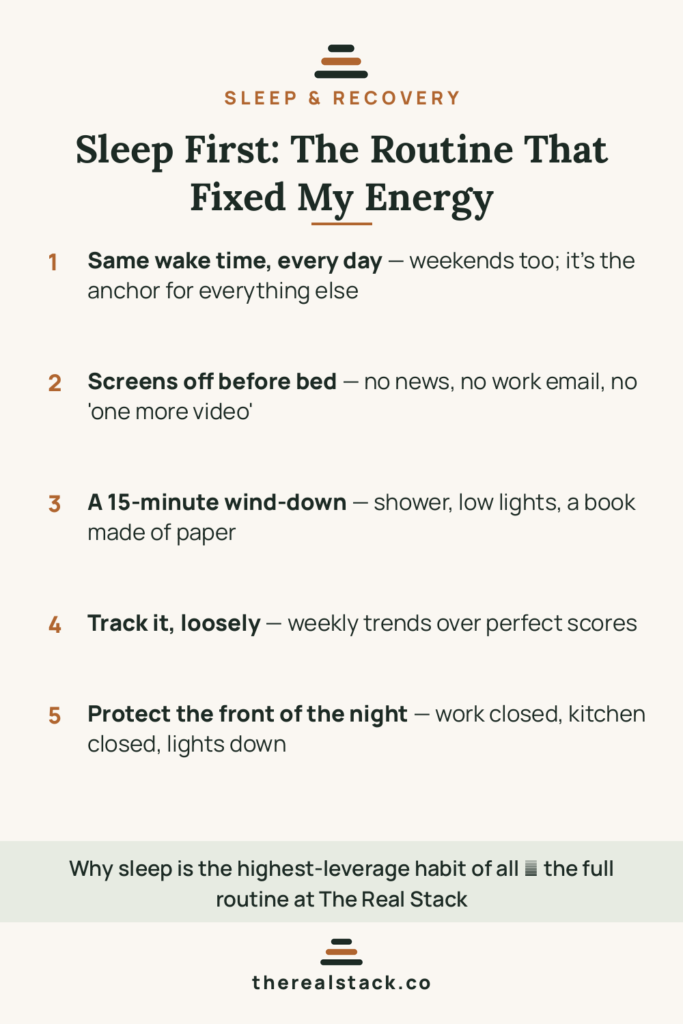
    1. Same wake time, every day — including weekends. This is the anchor. I get up at the same time within about a 30-minute window, seven days a week. It’s the single most powerful tool for stabilizing everything downstream: sleepiness arrives on schedule at night, and mornings stop being a negotiation. Sleeping in on Saturday felt like a reward; it was actually jet lag I gave myself weekly.
    2. Screens off before bed. In the last stretch before bed, I put the phone down and keep screen time to a minimum. The research here is consistent: evening light exposure and engaging content both delay sleep onset (work on evening light-emitting e-readers, published in PNAS, is a clean demonstration). But honestly, the bigger effect for me was behavioural — no news, no work email, no “one more video” at 11:40 p.m. The bedroom got boring, and boring is what you want.
    3. A wind-down that’s short enough to survive real life. Shower, lights low, a few minutes of stretching or reading something made of paper. Fifteen minutes, not an hour-long ceremony. A routine you’ll do at 80% compliance beats a perfect one you abandon in week two — especially on nights when bedtime with the kids runs long, which is most nights.
    4. Track it — but loosely. I wear a Whoop, mainly for sleep and recovery trends. What tracking actually taught me: my perceived sleep and my actual sleep were different things; alcohol — even a modest amount — visibly wrecked my recovery scores and my next day; and late, heavy meals cost me more sleep quality than caffeine timing did. I don’t chase a perfect score. I look at the week’s trend the way you’d glance at a fuel gauge. If you don’t want a wearable, a notebook with bed/wake times and a 1–10 morning rating gets you 70% of the insight for $4.
    5. Protect the front end of the night. With young kids, the hours after they’re down are the only adult hours in the day — I know exactly how precious they feel. I still guard a hard-ish stop: work closed, kitchen closed, lights down. The trade is real (less evening leisure) and worth it (a morning self who can train, work, and be patient). Nobody in my house misses the version of me who stayed up scrolling and paid for it until noon.

    What changed — honestly

    • Energy. The 3 p.m. crash mostly disappeared. Not “optimized” — just normal, stable energy, which at this stage of life feels like a superpower.
    • Training. Four dumbbell sessions a week, consistently, for the first time in years. Consistency was never a motivation problem; it was a recovery problem.
    • Weight. ~35 pounds in the past three months. Sleep didn’t burn the fat — eating mostly whole foods, adequate protein, creatine, and training did the mechanical work. But sleep made all of it sustainable: fewer cravings, better training, better decisions at 9 p.m. in front of the fridge.
    • Evenings, and my kids. I stopped falling asleep during bedtime stories. My evenings exist again — and instead of counting the minutes until I could sit down, I have the energy to get on the floor and play with my kids after dinner. Of everything on this list, that’s the one I’d have paid the most for.
    • Mood and patience. The least measurable and the most valuable. I am a better parent on seven-plus hours. It’s not close.

    Your first two weeks

    Don’t rebuild your life. Do this:

    1. Pick a wake time you can hold seven days a week. Set the alarm. That’s the whole first step.
    2. Count backwards 8 hours. That’s your lights-out target — aim to be in bed then, not starting to get ready then.
    3. Screens off for the last stretch before bed starting tonight. A $10 alarm clock removes the “I need my phone” excuse.
    4. Track bed time, wake time, and a 1–10 “how do I feel” score each morning. Paper is fine.
    5. After two weeks, look at the pattern — not any single night — and adjust one thing.

    That’s it. No stack, no protocol, no subscription. If you do only this, you will have done more for your healthspan than any compound this site will ever write about — including the famous ones.

    The bottom line

    Peptides promise recovery, resilience, and more good years. Sleep delivers measurable versions of all three, in actual human studies, for free, starting tonight. It’s not the whole program — training, food, and bloodwork matter, and this site covers all of them. But it’s the first domino, and in my house, it was the one that knocked over all the others.

    Start tonight. Same time tomorrow morning. I’ll be doing the same.

    Sources and further reading: American Academy of Sleep Medicine & Sleep Research Society consensus recommendation on adult sleep duration (7+ hours); Canadian 24-Hour Movement Guidelines for Adults (7–9 hours of good-quality sleep on a regular schedule); CDC resources on sleep and chronic disease; reviews of sleep restriction, appetite hormones, and energy intake in the sleep–metabolism literature; the Stanford sleep-extension study in collegiate basketball players (Sleep, 2011); evening light-emitting e-reader study (PNAS, 2015); UK Biobank cohort research on sleep regularity and mortality.

    This article reflects personal experience and general education; it is not medical advice. Persistent snoring, witnessed apneas, or chronic insomnia warrant a medical assessment. See our Disclaimer & Disclosure page.

  • BPC-157: What the Human Evidence Actually Shows

    BPC-157: What the Human Evidence Actually Shows

    If you’ve spent any time in longevity or fitness corners of the internet, you’ve met BPC-157. It’s sold — where it’s sold at all — as a near-miraculous healing compound: torn tendons knitting faster, guts repaired, injuries resolved. Podcasters swear by it. Clinics (the loosely regulated kind) offer it. Forums are full of recovery stories.

    So let’s do the thing almost nobody selling it will do: go through the evidence, layer by layer, and see what’s actually there.

    Quick note before we start: this is education, not medical advice, and this site never publishes doses, protocols, or sources for prescription or unapproved products. If you want the short version of this article, it’s this: the human evidence for BPC-157 is close to empty, and in Canada the product isn’t legal to sell. The long version is more interesting.

    BPC-157: what the human evidence actually shows — a checklist

    What BPC-157 is

    BPC-157 (“Body Protection Compound”) is a synthetic peptide — a short chain of amino acids — modelled on a protein fragment found in human gastric juice. It was developed in Croatia in the 1990s, and the bulk of the research on it comes from a single research group there. It’s most often discussed for tissue repair: tendons, ligaments, muscle, gut lining, even nerve injury.

    That origin story matters. A compound can be genuinely interesting to scientists and still be nowhere near proven in people. BPC-157 is the textbook case.

    The animal data: genuinely interesting

    Let’s be fair to the compound first. In animal studies — overwhelmingly in rats and mice — BPC-157 has produced striking results across a wide range of injury models: tendon and ligament healing, muscle repair, inflammatory bowel models, wound healing, even some neuroprotection models. Systematic reviews of the preclinical literature (a 2023-era review of the animal evidence is representative) describe consistent positive effects on healing and blood-vessel growth in rodents, with few adverse effects reported in those models.

    If you stopped reading there, you’d understand why people are excited. But here’s the thing about animal data: it’s the beginning of the evidence pipeline, not the end. The history of medicine is littered with compounds that healed rats beautifully and did nothing — or caused harm — in humans. Rodent metabolism, dosing scale, and injury models don’t transfer cleanly. That’s not cynicism; it’s why human trials exist.

    The human data: this is the part that matters

    And this is where the BPC-157 story gets very quiet.

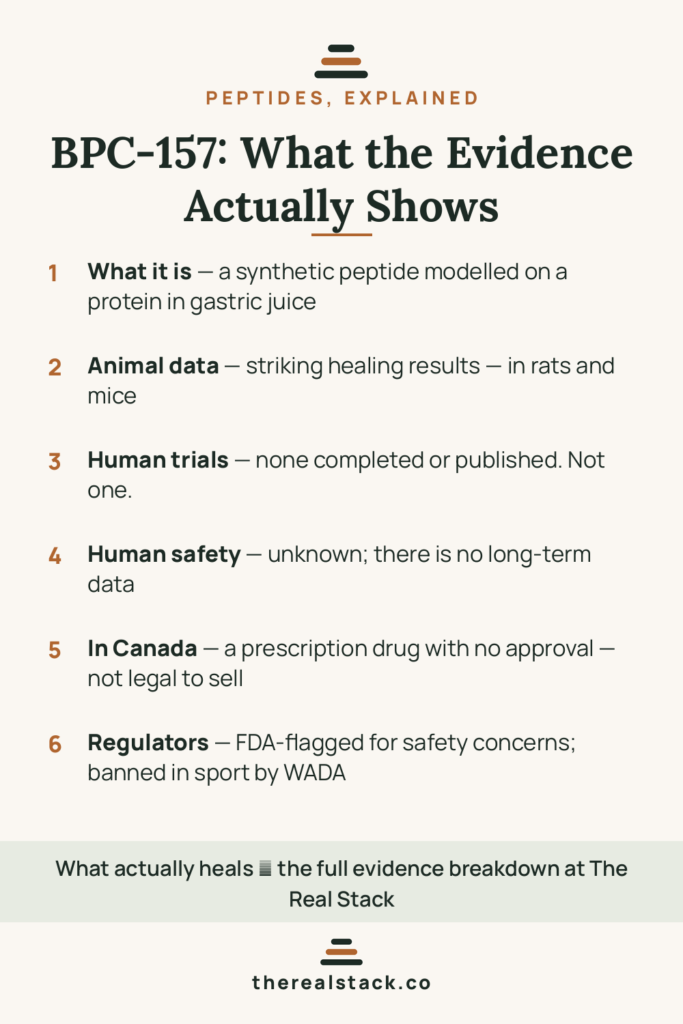
    There are no completed, published, randomized controlled trials of BPC-157 in humans. Not for tendons, not for gut health, not for anything. That single fact should frame every claim you ever hear about it.

    What human information exists is thin:

    • Small uncontrolled reports. The most-cited is a small retrospective case series involving intra-articular injections for chronic knee pain, in which most patients reported improvement. No control group, no blinding, no placebo comparison — the study design least able to separate a real effect from placebo, natural recovery, and the passage of time. Knee pain is notorious for improving in placebo arms of proper trials, which is exactly why controls exist.
    • Safety data is essentially absent. “No side effects reported in rat studies” is not a safety profile. Long-term human safety — effects on blood vessels, on cell growth pathways, on cancer risk — is simply unknown. A compound that promotes blood-vessel growth and tissue proliferation raises theoretical questions that only human data can answer, and there is none.
    • Regulators have noticed the gap. The U.S. Food and Drug Administration placed BPC-157 in Category 2 of its bulk substances list for compounding pharmacies — the category for substances with significant safety concerns and insufficient evidence — meaning U.S. compounding pharmacies can’t legally use it. The World Anti-Doping Agency bans it for athletes. Neither of those is what “proven and safe” looks like.

    So the honest summary: promising in rodents, unproven in humans, unknown safety profile. Anyone telling you more than that is selling something.

    The legal situation in Canada

    In Canada, BPC-157 is treated as a prescription drug, and no product containing it has been approved by Health Canada — there’s no Drug Identification Number (DIN) for it. Unauthorized BPC-157 products are not legal to sell in Canada, and Health Canada has warned about and acted against unauthorized peptide products sold online and in clinics.

    The websites offering it anyway typically label it “research use only” or “not for human consumption.” Understand what that is: a legal fig leaf, not a loophole. Health Canada has been clear that this labelling doesn’t make an unauthorized drug product legal — and the same sites often market the product with human-use claims one scroll away from the disclaimer. If a vendor’s legal strategy is a wink, consider what that tells you about their quality strategy.

    The grey-market product problem

    Even if you set the evidence and legality aside, there’s a more basic problem: you don’t know what’s in the vial.

    Regulated drugs pass through manufacturing standards, batch testing, and a supply chain with accountability. Grey-market peptides pass through none of that. Independent analyses of unregulated online health products routinely find products that are under-dosed, over-dosed, contaminated, or contain something else entirely. Peptides are also fragile molecules — heat and poor storage degrade them — and an anonymous online vendor has no regulator checking any of it. When people report that BPC-157 “did nothing,” or worse, had a bad reaction, there’s no way to know whether they even took BPC-157.

    The pivot: what actually heals

    Here’s the part of this article I’d actually like you to remember.

    The desire underneath BPC-157 is completely reasonable: you want to recover faster, heal nagging injuries, and not feel fragile in your 40s. That desire deserves interventions with human evidence behind them. Those exist — they’re just less marketable:

    • Sleep. Tissue repair, growth-hormone release, and pain sensitivity are all strongly sleep-dependent. Chronic short sleep measurably impairs wound healing and athletic recovery in human studies. This was the first thing I fixed in my own life — consistent wake time, screens off before bed, sleep tracked with a wearable — and it did more for my recovery and training than any supplement I’ve ever taken. I went from ~240 lbs to ~205 now, training four days a week, and sleep was the foundation the rest was built on.
    • Protein and total nutrition. Healing is construction; it needs raw materials. Adequate protein intake is one of the best-supported levers in sports-medicine nutrition research.
    • Progressive, patient loading. Tendons and ligaments adapt to gradually increasing load — this is the basis of evidence-based rehab (the eccentric and heavy-slow-resistance protocols used in physiotherapy). It’s slow. It also works in humans, which is the entire point.
    • Bloodwork and the basics. Iron, vitamin D, thyroid, blood sugar — deficiencies and metabolic problems quietly sabotage recovery, and a routine blood panel (much of it OHIP-covered in Ontario when your doctor orders it) finds them. Boring. Actionable.
    • Not re-injuring it. Load management and actual rest — the advice nobody wants — remain the highest-yield “protocol” in sports medicine.

    None of that fits in a vial or ships in discreet packaging. All of it has the thing BPC-157 doesn’t: evidence in people like you.

    The bottom line

    BPC-157 is a legitimately interesting research compound with a genuinely empty human evidence file, an unknown safety profile, no legal status as a sellable product in Canada, and a grey market that can’t guarantee what’s in the bottle. Maybe rigorous trials will someday change that picture. If they do, this page will be updated — that’s what following the evidence means.

    Until then, the fastest legal way to heal and recover better is the unglamorous list above. Start with sleep. It worked for me, and unlike a research chemical, it comes with decades of human data.

    Sources and further reading: preclinical systematic reviews of BPC-157 in animal models (e.g., reviews of the rodent tendon/ligament and gastrointestinal literature, 2020–2023); the published retrospective case series on intra-articular BPC-157 for knee pain; U.S. FDA Pharmacy Compounding Advisory Committee materials and the 503A Category 2 bulk substances list; WADA Prohibited List; Health Canada advisories on unauthorized peptide products and the Food and Drug Regulations on prescription (Schedule F) drugs.

    This article is education only and is not medical advice. If you have an injury or a health concern, see your own clinician or physiotherapist. See our Disclaimer & Disclosure page.