

If you’ve spent any time in longevity or fitness corners of the internet, you’ve met BPC-157. It’s sold — where it’s sold at all — as a near-miraculous healing compound: torn tendons knitting faster, guts repaired, injuries resolved. Podcasters swear by it. Clinics (the loosely regulated kind) offer it. Forums are full of recovery stories.
So let’s do the thing almost nobody selling it will do: go through the evidence, layer by layer, and see what’s actually there.
Quick note before we start: this is education, not medical advice, and this site never publishes doses, protocols, or sources for prescription or unapproved products. If you want the short version of this article, it’s this: the human evidence for BPC-157 is close to empty, and in Canada the product isn’t legal to sell. The long version is more interesting.
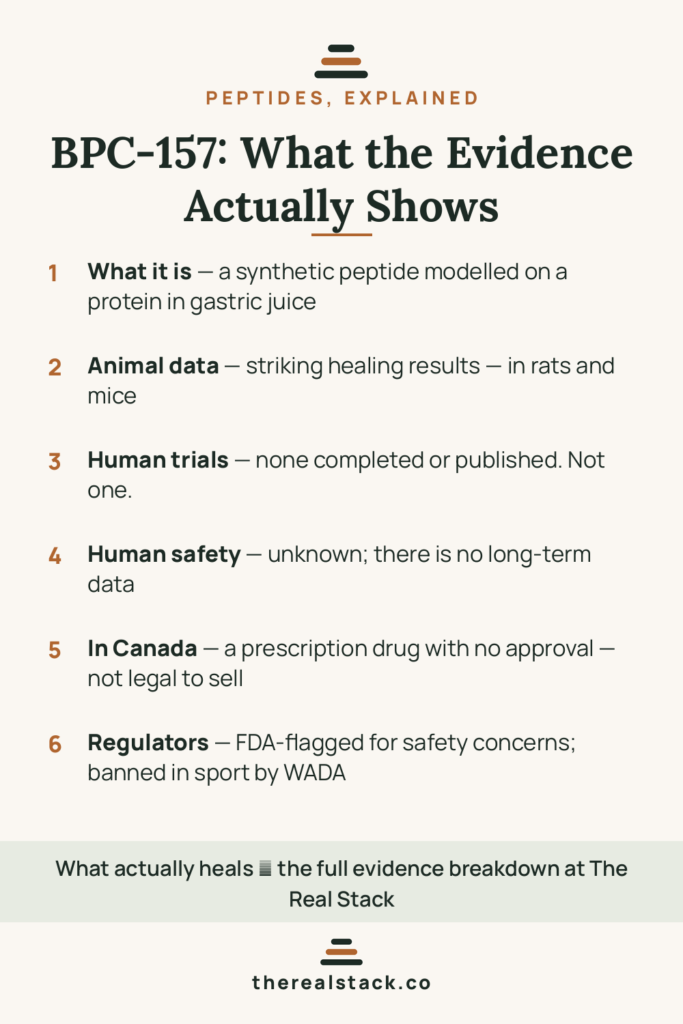
What BPC-157 is
BPC-157 (“Body Protection Compound”) is a synthetic peptide — a short chain of amino acids — modelled on a protein fragment found in human gastric juice. It was developed in Croatia in the 1990s, and the bulk of the research on it comes from a single research group there. It’s most often discussed for tissue repair: tendons, ligaments, muscle, gut lining, even nerve injury.
That origin story matters. A compound can be genuinely interesting to scientists and still be nowhere near proven in people. BPC-157 is the textbook case.
The animal data: genuinely interesting
Let’s be fair to the compound first. In animal studies — overwhelmingly in rats and mice — BPC-157 has produced striking results across a wide range of injury models: tendon and ligament healing, muscle repair, inflammatory bowel models, wound healing, even some neuroprotection models. Systematic reviews of the preclinical literature (a 2023-era review of the animal evidence is representative) describe consistent positive effects on healing and blood-vessel growth in rodents, with few adverse effects reported in those models.
If you stopped reading there, you’d understand why people are excited. But here’s the thing about animal data: it’s the beginning of the evidence pipeline, not the end. The history of medicine is littered with compounds that healed rats beautifully and did nothing — or caused harm — in humans. Rodent metabolism, dosing scale, and injury models don’t transfer cleanly. That’s not cynicism; it’s why human trials exist.
The human data: this is the part that matters
And this is where the BPC-157 story gets very quiet.
There are no completed, published, randomized controlled trials of BPC-157 in humans. Not for tendons, not for gut health, not for anything. That single fact should frame every claim you ever hear about it.
What human information exists is thin:
- Small uncontrolled reports. The most-cited is a small retrospective case series involving intra-articular injections for chronic knee pain, in which most patients reported improvement. No control group, no blinding, no placebo comparison — the study design least able to separate a real effect from placebo, natural recovery, and the passage of time. Knee pain is notorious for improving in placebo arms of proper trials, which is exactly why controls exist.
- Safety data is essentially absent. “No side effects reported in rat studies” is not a safety profile. Long-term human safety — effects on blood vessels, on cell growth pathways, on cancer risk — is simply unknown. A compound that promotes blood-vessel growth and tissue proliferation raises theoretical questions that only human data can answer, and there is none.
- Regulators have noticed the gap. The U.S. Food and Drug Administration placed BPC-157 in Category 2 of its bulk substances list for compounding pharmacies — the category for substances with significant safety concerns and insufficient evidence — meaning U.S. compounding pharmacies can’t legally use it. The World Anti-Doping Agency bans it for athletes. Neither of those is what “proven and safe” looks like.
So the honest summary: promising in rodents, unproven in humans, unknown safety profile. Anyone telling you more than that is selling something.
The legal situation in Canada
In Canada, BPC-157 is treated as a prescription drug, and no product containing it has been approved by Health Canada — there’s no Drug Identification Number (DIN) for it. Unauthorized BPC-157 products are not legal to sell in Canada, and Health Canada has warned about and acted against unauthorized peptide products sold online and in clinics.
The websites offering it anyway typically label it “research use only” or “not for human consumption.” Understand what that is: a legal fig leaf, not a loophole. Health Canada has been clear that this labelling doesn’t make an unauthorized drug product legal — and the same sites often market the product with human-use claims one scroll away from the disclaimer. If a vendor’s legal strategy is a wink, consider what that tells you about their quality strategy.
The grey-market product problem
Even if you set the evidence and legality aside, there’s a more basic problem: you don’t know what’s in the vial.
Regulated drugs pass through manufacturing standards, batch testing, and a supply chain with accountability. Grey-market peptides pass through none of that. Independent analyses of unregulated online health products routinely find products that are under-dosed, over-dosed, contaminated, or contain something else entirely. Peptides are also fragile molecules — heat and poor storage degrade them — and an anonymous online vendor has no regulator checking any of it. When people report that BPC-157 “did nothing,” or worse, had a bad reaction, there’s no way to know whether they even took BPC-157.
The pivot: what actually heals
Here’s the part of this article I’d actually like you to remember.
The desire underneath BPC-157 is completely reasonable: you want to recover faster, heal nagging injuries, and not feel fragile in your 40s. That desire deserves interventions with human evidence behind them. Those exist — they’re just less marketable:
- Sleep. Tissue repair, growth-hormone release, and pain sensitivity are all strongly sleep-dependent. Chronic short sleep measurably impairs wound healing and athletic recovery in human studies. This was the first thing I fixed in my own life — consistent wake time, screens off before bed, sleep tracked with a wearable — and it did more for my recovery and training than any supplement I’ve ever taken. I went from ~240 lbs to ~205 now, training four days a week, and sleep was the foundation the rest was built on.
- Protein and total nutrition. Healing is construction; it needs raw materials. Adequate protein intake is one of the best-supported levers in sports-medicine nutrition research.
- Progressive, patient loading. Tendons and ligaments adapt to gradually increasing load — this is the basis of evidence-based rehab (the eccentric and heavy-slow-resistance protocols used in physiotherapy). It’s slow. It also works in humans, which is the entire point.
- Bloodwork and the basics. Iron, vitamin D, thyroid, blood sugar — deficiencies and metabolic problems quietly sabotage recovery, and a routine blood panel (much of it OHIP-covered in Ontario when your doctor orders it) finds them. Boring. Actionable.
- Not re-injuring it. Load management and actual rest — the advice nobody wants — remain the highest-yield “protocol” in sports medicine.
None of that fits in a vial or ships in discreet packaging. All of it has the thing BPC-157 doesn’t: evidence in people like you.
The bottom line
BPC-157 is a legitimately interesting research compound with a genuinely empty human evidence file, an unknown safety profile, no legal status as a sellable product in Canada, and a grey market that can’t guarantee what’s in the bottle. Maybe rigorous trials will someday change that picture. If they do, this page will be updated — that’s what following the evidence means.
Until then, the fastest legal way to heal and recover better is the unglamorous list above. Start with sleep. It worked for me, and unlike a research chemical, it comes with decades of human data.
Sources and further reading: preclinical systematic reviews of BPC-157 in animal models (e.g., reviews of the rodent tendon/ligament and gastrointestinal literature, 2020–2023); the published retrospective case series on intra-articular BPC-157 for knee pain; U.S. FDA Pharmacy Compounding Advisory Committee materials and the 503A Category 2 bulk substances list; WADA Prohibited List; Health Canada advisories on unauthorized peptide products and the Food and Drug Regulations on prescription (Schedule F) drugs.
This article is education only and is not medical advice. If you have an injury or a health concern, see your own clinician or physiotherapist. See our Disclaimer & Disclosure page.
Leave a Reply