
Category: Peptides, Explained

  • Peptides in Canada: The Legal Reality (and Why “Research Use Only” Isn’t a Loophole)

    Peptides in Canada: The Legal Reality (and Why “Research Use Only” Isn’t a Loophole)

    If you’ve spent any time looking at peptides online, you’ve seen two things side by side: a website selling vials with human-use claims all over it, and a small label saying “research use only” or “not for human consumption.” Those two things can’t both be true — and in Canada, the law agrees with the label reader, not the marketer.

    This article is the plain-language version: what’s a prescription drug, what Health Canada has said and done, why the common loopholes aren’t loopholes, what you can get legally, and what to do if you’re genuinely curious.

    Education only, not legal advice and not medical advice. Rules change, and this is a snapshot of the law as it stands in late 2026 — if you’re making a decision, check Health Canada’s current guidance and talk to a clinician.
    Are peptides legal in Canada? The legal reality

    The starting point: most of these are prescription drugs

    In Canada, a drug’s legal status doesn’t depend on how it’s marketed online. It depends on what it is. Most of the peptides discussed in longevity and fitness circles — BPC-157, TB-500, GHK-Cu, CJC-1295, ipamorelin, MOTS-c, epithalon and others — are treated as prescription drugs under Canadian law. That means:

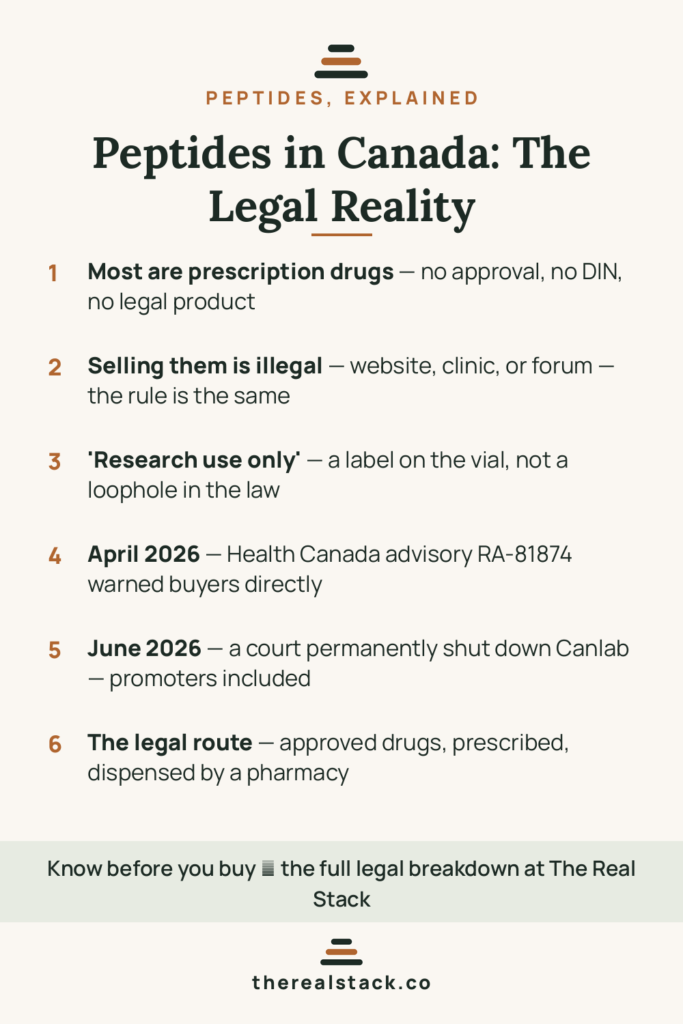
    • No product containing them has been approved by Health Canada. There is no Drug Identification Number (DIN) for them. A DIN is the basic marker of a legal drug product in Canada — without one, a product isn’t authorized for sale.
    • Selling them is illegal. Unauthorized products containing prescription drugs are not legal to sell in Canada, whether the seller is a website, a clinic, or a guy on a forum.
    • “But it’s just a peptide” doesn’t change anything. Peptides are drugs when they act like drugs. That some are short chains of amino acids, or that your body makes related molecules naturally, is legally irrelevant.

    The grey market isn’t a grey area — it’s an illegal market operating in the open, and the openness is the trick.

    What Health Canada has said — and done

    Health Canada hasn’t been vague about this. In an advisory dated April 9, 2026 (reference RA-81874), it warned Canadians about unauthorized peptide products — including BPC-157, TB-500, and similar compounds — sold online and in clinics, noting they are not authorized, their safety and quality are unverified, and they carry real risks. The advisory is the regulator speaking directly to consumers: these products are not approved, and buying them is buying blind.

    And it hasn’t stopped at warnings. On June 11, 2026, a court granted a permanent injunction against Canlab, a Canadian seller of unauthorized injectable peptides — and the injunction doesn’t just bar selling the products, it bars assisting others in advertising unauthorized injectable drugs. That reach is what matters: it covers the promoters, not just the seller.

    I mention these two specifically because they’re verifiable, dated, and public — not rumours. RA-81874 (April 2026) and the Canlab injunction (June 2026) are the two facts to keep in your pocket when someone tells you “everyone does it, so it must be fine.” Everyone does it, and the regulator has still said no — twice, in writing, with consequences.

    Why “research use only” isn’t a loophole

    This is the claim you’ll see most often, so let’s take it apart properly.

    The label “research use only” (or “not for human consumption”) is a seller’s attempt to reclassify a drug as a laboratory chemical. The argument, roughly, is: we’re not selling a drug for people, we’re selling a chemical for research, so the drug rules don’t apply. Health Canada has been explicit that this doesn’t work. Whether a product is a drug depends on what it is and how it’s presented — and when a website sells a vial with human-use claims one scroll away from a “research use only” disclaimer, the presentation gives the game away.

    If a label could exempt a product from drug law, every unauthorized drug in the country would carry one. The label is a fig leaf — and the fact that a seller needs one tells you they know exactly what they’re selling.

    The same logic applies to the other evasions you’ll see: selling it as a “cosmetic” or “supplement,” shipping from a warehouse in another country, or routing payment through a processor that doesn’t ask questions. None of these change the product’s legal status in Canada. They change how hard it is to catch the seller — which is a different thing, and not your protection.

    The advertising rule most promoters don’t know they’re breaking

    Here’s the part that surprises people, including a lot of content creators: in Canada, consumer advertising of prescription drugs is heavily restricted. For a prescription drug, the law allows advertising to the public of name, price, and quantity only — no claims about what it does, no benefits, no testimonials, no before-and-after stories.

    Health Canada treats anyone who promotes a specific product’s sale as advertising it — including affiliate content. A post that links to a peptide vendor with a discount code isn’t “just sharing information”; it’s advertising a prescription drug to the public, with claims attached, which the law doesn’t allow. The Canlab injunction’s reach into assisting others to advertise is the enforcement version of exactly this point.

    That’s why this site’s rule is absolute: peptide content here carries no product links, no vendor names, no discount codes, and no promotion of any kind. It’s not caution for its own sake — it’s the law, and the regulator has already shown it will enforce it.

    What you CAN get legally in Canada

    The legal picture isn’t “no peptides, ever” — it’s “approved peptides, through proper channels”:

    • Approved peptide drugs, prescribed by a clinician and dispensed by a licensed pharmacy. The clearest example is the GLP-1 class — drugs like semaglutide — approved in Canada with DINs, prescribed for specific indications, and dispensed through regulated pharmacies. If a peptide has a DIN, a prescription, and a pharmacy, it’s in the legal system.
    • Compounding — done properly. A licensed pharmacy can prepare a compounded medication for an individual patient, on a valid prescription, when a commercial product isn’t suitable. That’s a real, legal route — and it is not what grey-market vials are. A compounded prescription is made for one named patient, by a regulated pharmacy, under a clinician’s care. A vial bought from a website is none of those things. The difference is accountability, quality control, and a clinician who knows your history.
    • What a legitimate clinician will and won’t do. A doctor can discuss peptides, order relevant bloodwork, and prescribe approved drugs where they’re indicated. A doctor cannot legally prescribe BPC-157 or TB-500 — there’s no approved product to prescribe. If a clinic offers you those compounds, it’s selling an unauthorized product, whatever the white coat suggests.

    What happens if you buy anyway

    The practical consequences, which the sellers won’t tell you:

    • No regulator to complain to. If the product is contaminated, mislabelled, or harms you, there is no recall system and no regulator who can make it right. Regulated drugs come with a safety net. Grey-market products come with a “good luck.”
    • Product quality is unknowable. Independent analyses of unregulated online health products routinely find under-dosed, over-dosed, contaminated, or mislabelled products. Peptides are fragile molecules — heat and poor storage degrade them — and an anonymous vendor has no one checking any of it.
    • Payment and supply risk. Grey-market sellers operate outside normal payment processing, which is why they cycle through processors, crypto, and e-transfers. Orders get seized, vendors disappear, and refunds are a rumour. Several large peptide vendors shut down in 2026 alone.
    • Legal exposure is mostly the seller’s. Enforcement in Canada has focused on sellers and promoters, not individual buyers. That’s worth knowing honestly. But “unlikely to be prosecuted” is not the same as “legal,” and it’s a thin basis for putting an unverified injectable into your body.

    How to talk to a clinician about it

    If you’re genuinely curious, the productive move is a conversation with your own doctor, not a purchase:

    • Say what you’re interested in and why. “I’ve been reading about peptides for recovery — what does the evidence actually show?” is a good opening. A good clinician will have heard it before.
    • Bring the honest question, not the conclusion. The question isn’t “will you prescribe me BPC-157?” (they can’t). It’s “is there anything in my situation — sleep, hormones, iron, vitamin D, thyroid — that explains why my recovery is slow?” That’s a question with an answer, and often a fixable one.
    • Ask for the bloodwork. A routine panel — much of it OHIP-covered in Ontario when your doctor orders it — finds the deficiencies and metabolic problems that quietly sabotage recovery. It’s the boring, actionable version of what the peptide hype promises.
    • If a clinic offers you peptides, ask three questions: Is this product approved in Canada? Does it have a DIN? Who is the licensed pharmacy dispensing it? Evasive answers are your answer.

    The bottom line

    In Canada, the peptides that dominate the longevity conversation are prescription drugs with no approval, no DIN, and no legal route to sale. Health Canada said so in writing in April 2026 (advisory RA-81874) and a court backed it up with a permanent injunction in June 2026. “Research use only” is not a loophole, affiliate promotion counts as advertising, and the only legal peptides are approved ones prescribed by a clinician and dispensed by a licensed pharmacy.

    None of that means your underlying goal is wrong. Wanting to recover faster, heal better, and stay strong in your 40s is completely reasonable — it’s the same goal that built this site. It just means the legal, evidence-backed route to it isn’t a vial. It’s the unglamorous list this site keeps coming back to: sleep first (I wrote up the routine that changed everything for me here: Sleep: The Highest-Leverage Healthspan Habit Nobody Can Sell You), adequate protein, progressive training, routine bloodwork, and rest. All of it legal, all of it with human evidence behind it.

    Sources and further reading: Health Canada advisory RA-81874 (April 9, 2026) on unauthorized peptide products; the June 11, 2026 permanent injunction against Canlab; Health Canada guidance on the advertising of prescription drugs to consumers (Food and Drugs Act and Food and Drug Regulations, including the name/price/quantity restriction); the Prescription Drug List (Schedule F) and the Drug Identification Number system; Health Canada advisories on unauthorized peptide products sold online and in clinics.

    This article is education only — not legal advice and not medical advice. Rules change; check Health Canada’s current guidance and talk to your own clinician about any health decision. See our Disclaimer & Disclosure page.

  • TB-500: What the Human Evidence Actually Shows

    TB-500: What the Human Evidence Actually Shows

    If BPC-157 is the most searched peptide, TB-500 is its constant companion. Scroll any forum thread about healing, and you’ll find the pair sold as a stack: BPC-157 for this, TB-500 for that, together for faster recovery from everything. The pairing sounds scientific. It isn’t — it’s marketing that borrowed a real protein’s reputation and stapled it to a compound with almost no human data of its own.

    So let’s do the same thing we did with BPC-157: go through the evidence layer by layer, and separate what belongs to TB-500 from what belongs to something else entirely.

    Quick note: this is education, not medical advice, and this site never publishes doses, protocols, or sources for prescription or unapproved products. Short version: there are no completed human trials of TB-500, and in Canada it isn’t legal to sell. The long version is worth reading, because the confusion around this one is the whole story.

    TB-500 explained: what it is and what the evidence shows

    What TB-500 is

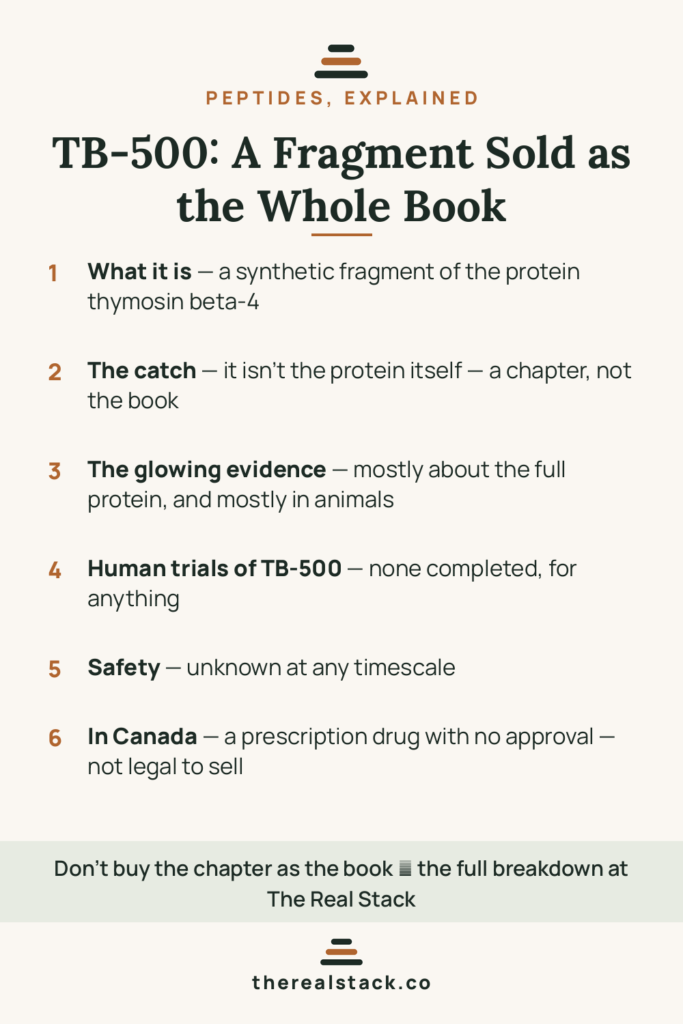
    TB-500 is a synthetic peptide — a short chain of amino acids — modelled on a fragment of thymosin beta-4, a protein your body makes naturally. Thymosin beta-4 is a 43-amino-acid protein found in nearly every cell, and its best-understood job is regulating actin, the scaffolding protein that lets cells move, change shape, and repair tissue. It’s involved in wound healing, blood-vessel formation, and the inflammatory response — which is exactly why researchers have been interested in it for decades.

    Here’s the distinction that matters, and that almost no seller will make for you: TB-500 is not thymosin beta-4. It’s a synthetic fragment derived from part of the thymosin beta-4 sequence. The two are related the way a single chapter is related to a whole book. Evidence about the full protein does not automatically transfer to the fragment, and evidence about the fragment in animals does not automatically transfer to people. Most of the confident claims you’ll read about TB-500 quietly slide between those three things — the protein, the fragment, and you — as if they were the same. They aren’t.

    The animal and cell data: interesting — about a different molecule

    Let’s be fair to the underlying science first, because thymosin beta-4 is genuinely interesting. In cell and animal studies, the full protein has shown effects on wound closure, corneal healing, cardiac repair after induced heart injury in animals, and blood-vessel growth. That’s a real research literature, built over decades, and it’s the reason the compound family keeps attracting attention.

    But notice what I just described: the full protein, mostly in animals and cells. The evidence for TB-500 itself — the synthetic fragment people actually buy — is a much thinner file, mostly animal and cell work of the same early-stage kind: faster wound closure in rodents, some tissue-repair signals. And even the thymosin beta-4 literature is preclinical at its core. Interesting, hypothesis-generating, and not evidence that a fragment of it heals injuries in a 40-something human.

    This is the pattern from the BPC-157 article, one step worse: with BPC-157, at least the animal data was about BPC-157. With TB-500, a large share of the impressive-sounding evidence is about a related but different molecule.

    The human data: essentially empty — for TB-500

    There are no completed, published, randomized controlled trials of TB-500 in humans. Not for tendons, not for muscle, not for recovery, not for anything.

    What human data exists belongs to other compounds, and you need to know the difference when you see it cited:

    • Thymosin beta-4 in eye drops. The full protein has been studied in humans as an eye drop formulation for dry eye and corneal wound healing, in small trials. That’s a different compound, a different route, a different condition — and even that work is early-stage, not an established treatment. If someone cites “human trials of thymosin beta-4” as proof TB-500 works for your shoulder, they’re doing the chapter-for-the-book trick.
    • Anecdotes and forum reports. The usual uncontrolled stories: someone recovered, someone didn’t, nobody measured anything, and the product itself was unverified. The weakest evidence there is.
    • Safety data: essentially absent. As with BPC-157, “no side effects reported in rat studies” is not a safety profile. A molecule involved in cell migration and blood-vessel growth raises theoretical questions — including about abnormal cell growth — that only human data can answer. There is none, for TB-500, at any timescale.

    So the honest summary, one line: a fragment of an interesting protein, with no human trials of its own and an unknown safety profile. The “healing stack” is two compounds with empty human files, sold together because the story sounds better in pairs.

    The legal situation in Canada

    Same as BPC-157, and for the same reasons. In Canada, TB-500 is treated as a prescription drug, and no product containing it has been approved by Health Canada — there is no Drug Identification Number (DIN) for it. Unauthorized TB-500 products are not legal to sell in Canada, and Health Canada has warned about and acted against unauthorized peptide products sold online and in clinics.

    The “research use only” label on the vial is the same fig leaf as before: Health Canada has been clear that this labelling doesn’t make an unauthorized drug product legal. And the same warning applies to the vendor’s logic — if the legal strategy is a wink, consider what that tells you about the quality strategy.

    The regulators and the grey market

    • The U.S. FDA has placed TB-500 among the bulk substances it considers to raise significant safety concerns with insufficient evidence — the same category BPC-157 sits in — meaning U.S. compounding pharmacies can’t legally use it.
    • The World Anti-Doping Agency bans it for athletes. If you compete in any tested sport, TB-500 is a disqualification waiting for a test, not a recovery aid.
    • The grey-market problem is identical to BPC-157’s, and just as basic: you don’t know what’s in the vial. Regulated drugs pass through manufacturing standards, batch testing, and a supply chain with accountability. Grey-market peptides pass through none of that. Independent analyses of unregulated online health products routinely find products that are under-dosed, over-dosed, contaminated, or contain something else entirely. Peptides are fragile molecules — heat and poor storage degrade them — and an anonymous online vendor has no regulator checking any of it. With TB-500 there’s an extra wrinkle: because the compound is defined by its relationship to thymosin beta-4, a buyer has even less ability to know whether what’s in the vial is TB-500, some other fragment, or nothing at all.

    The pivot: what actually heals

    The desire underneath the “healing stack” is completely reasonable — the same one behind BPC-157: you want to recover faster, heal nagging injuries, and not feel fragile in your 40s. It deserves interventions with human evidence behind them. Those exist, and they’re the same list, because the body heals the same way regardless of which vial you’re reading about:

    • Sleep. Tissue repair, growth-hormone release, and pain sensitivity are all strongly sleep-dependent. Chronic short sleep measurably impairs wound healing and athletic recovery in human studies. This was the first thing I fixed in my own life — consistent wake time, screens off before bed, sleep tracked with a wearable — and it did more for my recovery and training than any supplement I’ve ever taken. I went from ~240 lbs to ~205 now, training four days a week, and sleep was the foundation the rest was built on. I wrote up the full routine here: Sleep: The Highest-Leverage Healthspan Habit Nobody Can Sell You.
    • Protein and total nutrition. Healing is construction; it needs raw materials. Adequate protein intake is one of the best-supported levers in sports-medicine nutrition research.
    • Progressive, patient loading. Tendons and ligaments adapt to gradually increasing load — this is the basis of evidence-based rehab (the eccentric and heavy-slow-resistance protocols used in physiotherapy). It’s slow. It also works in humans, which is the entire point.
    • Bloodwork and the basics. Iron, vitamin D, thyroid, blood sugar — deficiencies and metabolic problems quietly sabotage recovery, and a routine blood panel (much of it OHIP-covered in Ontario when your doctor orders it) finds them. Boring. Actionable.
    • Not re-injuring it. Load management and actual rest — the advice nobody wants — remain the highest-yield “protocol” in sports medicine.

    None of that fits in a vial or ships in discreet packaging. All of it has the thing TB-500 doesn’t: evidence in people like you.

    The bottom line

    TB-500 is a synthetic fragment of an interesting protein, sold on the reputation of a molecule it isn’t, with no completed human trials of its own, an unknown safety profile, no legal status as a sellable product in Canada, a ban from WADA, and a grey market that can’t guarantee what’s in the bottle. Maybe rigorous trials will someday change that picture. If they do, this page will be updated — that’s what following the evidence means.

    Until then, the fastest legal way to heal and recover better is the unglamorous list above. Start with sleep. It worked for me, and unlike a research chemical, it comes with decades of human data.

    Sources and further reading: the preclinical literature on thymosin beta-4 in wound healing, corneal repair, and cardiac injury models in animals; published reports on thymosin beta-4 eye-drop formulations in small human studies for dry eye and corneal healing; U.S. FDA Pharmacy Compounding Advisory Committee materials and the 503A Category 2 bulk substances list; WADA Prohibited List; Health Canada advisories on unauthorized peptide products and the Food and Drug Regulations on prescription (Schedule F) drugs.

    This article is education only and is not medical advice. If you have an injury or a health concern, see your own clinician or physiotherapist. See our Disclaimer & Disclosure page.

  • BPC-157: What the Human Evidence Actually Shows

    BPC-157: What the Human Evidence Actually Shows

    If you’ve spent any time in longevity or fitness corners of the internet, you’ve met BPC-157. It’s sold — where it’s sold at all — as a near-miraculous healing compound: torn tendons knitting faster, guts repaired, injuries resolved. Podcasters swear by it. Clinics (the loosely regulated kind) offer it. Forums are full of recovery stories.

    So let’s do the thing almost nobody selling it will do: go through the evidence, layer by layer, and see what’s actually there.

    Quick note before we start: this is education, not medical advice, and this site never publishes doses, protocols, or sources for prescription or unapproved products. If you want the short version of this article, it’s this: the human evidence for BPC-157 is close to empty, and in Canada the product isn’t legal to sell. The long version is more interesting.

    BPC-157: what the human evidence actually shows — a checklist

    What BPC-157 is

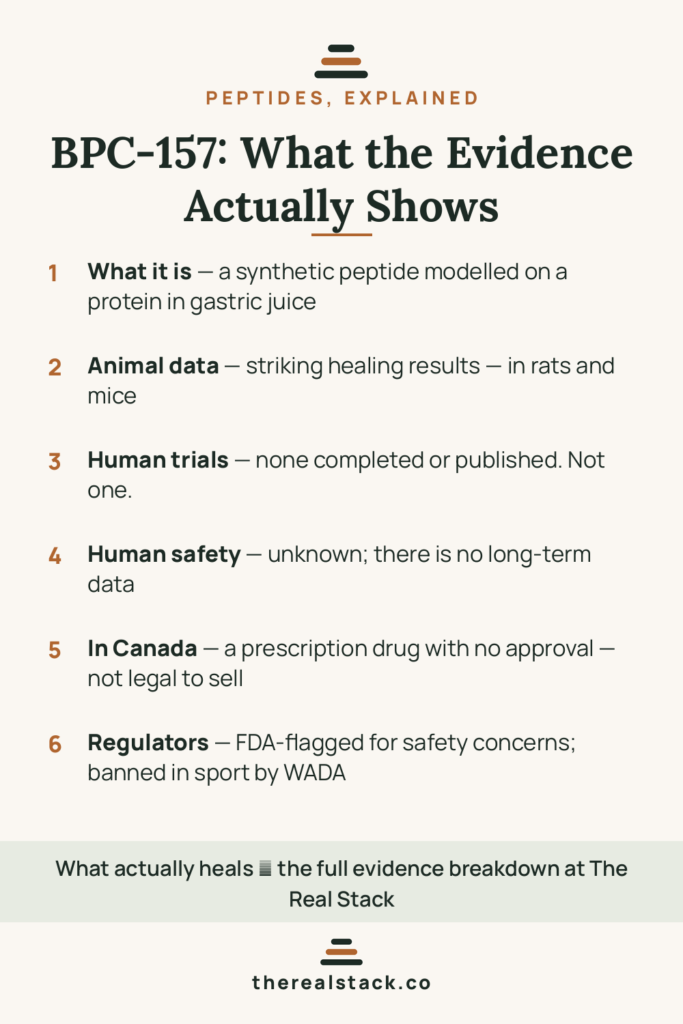
    BPC-157 (“Body Protection Compound”) is a synthetic peptide — a short chain of amino acids — modelled on a protein fragment found in human gastric juice. It was developed in Croatia in the 1990s, and the bulk of the research on it comes from a single research group there. It’s most often discussed for tissue repair: tendons, ligaments, muscle, gut lining, even nerve injury.

    That origin story matters. A compound can be genuinely interesting to scientists and still be nowhere near proven in people. BPC-157 is the textbook case.

    The animal data: genuinely interesting

    Let’s be fair to the compound first. In animal studies — overwhelmingly in rats and mice — BPC-157 has produced striking results across a wide range of injury models: tendon and ligament healing, muscle repair, inflammatory bowel models, wound healing, even some neuroprotection models. Systematic reviews of the preclinical literature (a 2023-era review of the animal evidence is representative) describe consistent positive effects on healing and blood-vessel growth in rodents, with few adverse effects reported in those models.

    If you stopped reading there, you’d understand why people are excited. But here’s the thing about animal data: it’s the beginning of the evidence pipeline, not the end. The history of medicine is littered with compounds that healed rats beautifully and did nothing — or caused harm — in humans. Rodent metabolism, dosing scale, and injury models don’t transfer cleanly. That’s not cynicism; it’s why human trials exist.

    The human data: this is the part that matters

    And this is where the BPC-157 story gets very quiet.

    There are no completed, published, randomized controlled trials of BPC-157 in humans. Not for tendons, not for gut health, not for anything. That single fact should frame every claim you ever hear about it.

    What human information exists is thin:

    • Small uncontrolled reports. The most-cited is a small retrospective case series involving intra-articular injections for chronic knee pain, in which most patients reported improvement. No control group, no blinding, no placebo comparison — the study design least able to separate a real effect from placebo, natural recovery, and the passage of time. Knee pain is notorious for improving in placebo arms of proper trials, which is exactly why controls exist.
    • Safety data is essentially absent. “No side effects reported in rat studies” is not a safety profile. Long-term human safety — effects on blood vessels, on cell growth pathways, on cancer risk — is simply unknown. A compound that promotes blood-vessel growth and tissue proliferation raises theoretical questions that only human data can answer, and there is none.
    • Regulators have noticed the gap. The U.S. Food and Drug Administration placed BPC-157 in Category 2 of its bulk substances list for compounding pharmacies — the category for substances with significant safety concerns and insufficient evidence — meaning U.S. compounding pharmacies can’t legally use it. The World Anti-Doping Agency bans it for athletes. Neither of those is what “proven and safe” looks like.

    So the honest summary: promising in rodents, unproven in humans, unknown safety profile. Anyone telling you more than that is selling something.

    The legal situation in Canada

    In Canada, BPC-157 is treated as a prescription drug, and no product containing it has been approved by Health Canada — there’s no Drug Identification Number (DIN) for it. Unauthorized BPC-157 products are not legal to sell in Canada, and Health Canada has warned about and acted against unauthorized peptide products sold online and in clinics.

    The websites offering it anyway typically label it “research use only” or “not for human consumption.” Understand what that is: a legal fig leaf, not a loophole. Health Canada has been clear that this labelling doesn’t make an unauthorized drug product legal — and the same sites often market the product with human-use claims one scroll away from the disclaimer. If a vendor’s legal strategy is a wink, consider what that tells you about their quality strategy.

    The grey-market product problem

    Even if you set the evidence and legality aside, there’s a more basic problem: you don’t know what’s in the vial.

    Regulated drugs pass through manufacturing standards, batch testing, and a supply chain with accountability. Grey-market peptides pass through none of that. Independent analyses of unregulated online health products routinely find products that are under-dosed, over-dosed, contaminated, or contain something else entirely. Peptides are also fragile molecules — heat and poor storage degrade them — and an anonymous online vendor has no regulator checking any of it. When people report that BPC-157 “did nothing,” or worse, had a bad reaction, there’s no way to know whether they even took BPC-157.

    The pivot: what actually heals

    Here’s the part of this article I’d actually like you to remember.

    The desire underneath BPC-157 is completely reasonable: you want to recover faster, heal nagging injuries, and not feel fragile in your 40s. That desire deserves interventions with human evidence behind them. Those exist — they’re just less marketable:

    • Sleep. Tissue repair, growth-hormone release, and pain sensitivity are all strongly sleep-dependent. Chronic short sleep measurably impairs wound healing and athletic recovery in human studies. This was the first thing I fixed in my own life — consistent wake time, screens off before bed, sleep tracked with a wearable — and it did more for my recovery and training than any supplement I’ve ever taken. I went from ~240 lbs to ~205 now, training four days a week, and sleep was the foundation the rest was built on.
    • Protein and total nutrition. Healing is construction; it needs raw materials. Adequate protein intake is one of the best-supported levers in sports-medicine nutrition research.
    • Progressive, patient loading. Tendons and ligaments adapt to gradually increasing load — this is the basis of evidence-based rehab (the eccentric and heavy-slow-resistance protocols used in physiotherapy). It’s slow. It also works in humans, which is the entire point.
    • Bloodwork and the basics. Iron, vitamin D, thyroid, blood sugar — deficiencies and metabolic problems quietly sabotage recovery, and a routine blood panel (much of it OHIP-covered in Ontario when your doctor orders it) finds them. Boring. Actionable.
    • Not re-injuring it. Load management and actual rest — the advice nobody wants — remain the highest-yield “protocol” in sports medicine.

    None of that fits in a vial or ships in discreet packaging. All of it has the thing BPC-157 doesn’t: evidence in people like you.

    The bottom line

    BPC-157 is a legitimately interesting research compound with a genuinely empty human evidence file, an unknown safety profile, no legal status as a sellable product in Canada, and a grey market that can’t guarantee what’s in the bottle. Maybe rigorous trials will someday change that picture. If they do, this page will be updated — that’s what following the evidence means.

    Until then, the fastest legal way to heal and recover better is the unglamorous list above. Start with sleep. It worked for me, and unlike a research chemical, it comes with decades of human data.

    Sources and further reading: preclinical systematic reviews of BPC-157 in animal models (e.g., reviews of the rodent tendon/ligament and gastrointestinal literature, 2020–2023); the published retrospective case series on intra-articular BPC-157 for knee pain; U.S. FDA Pharmacy Compounding Advisory Committee materials and the 503A Category 2 bulk substances list; WADA Prohibited List; Health Canada advisories on unauthorized peptide products and the Food and Drug Regulations on prescription (Schedule F) drugs.

    This article is education only and is not medical advice. If you have an injury or a health concern, see your own clinician or physiotherapist. See our Disclaimer & Disclosure page.