

If you read my supplement article, you saw the rule I run my whole routine by: one trial at a time, four to eight weeks, bloodwork before and after. This article is the bloodwork half of that system — what I test, why, and the part that surprised me most when I looked into it:
In Ontario, almost the entire core longevity panel is already paid for by OHIP — as long as a clinician orders it. The expensive part of “longevity testing” in Canada usually isn’t the tests. It’s the membership wrapped around them.
I’m in my early 40s, I lost about 35 pounds in the last few months, and I take a small stack of supplements (the honest grading is in the stack article). Bloodwork is how I check that the whole project is actually working — and how I catch the things a bathroom scale can’t see. Here’s the panel, what it costs, and how to get it.
Not medical advice — just one person’s experience plus the published evidence and Ontario’s actual coverage rules. Bloodwork needs a clinician to order it and interpret it in context. If something comes back flagged, that’s a conversation for your doctor, not a search engine.
Why bloodwork at all
Weight, sleep scores, and how your clothes fit are real signals, but they’re lagging and incomplete. A basic panel tells you, early and cheaply:
- Metabolic health — are you drifting toward insulin resistance while your weight looks fine?
- Cardiovascular risk — the markers that predict heart disease decades out, not next year.
- Liver and kidney function — the quiet organs that supplements, alcohol, and hard training all pass through.
- Hormones and micronutrients — thyroid, testosterone, iron, B12, vitamin D: the stuff that explains “I feel off” when everything else looks normal.
The point isn’t a 100-marker fishing expedition. It’s a short list of markers with strong evidence behind them, measured consistently, so you can see trends. One reading is a snapshot; the same panel every 6–12 months is a story.
The core panel — and what OHIP covers
Here’s the panel I work from, with Ontario coverage as of late 2026. The headline: since April 1, 2026, Ontario’s insured lab schedule includes ApoB and Lp(a) when ordered per Canadian Cardiovascular Society guidance — which means the two most useful modern cardiovascular markers joined the already-insured basics.
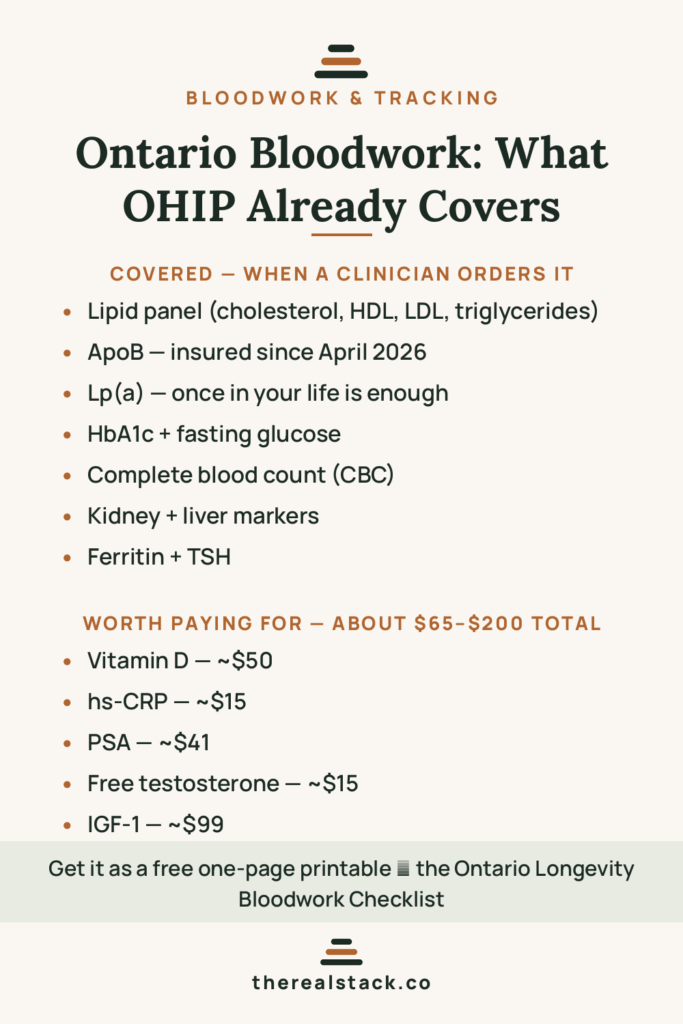
Insured when a clinician orders them (no charge at the lab):
- Lipid panel — total cholesterol, HDL, LDL, triglycerides
- ApoB — arguably a better measure of atherogenic particle count than LDL alone; insured since April 2026
- Lp(a) — a largely genetic cardiovascular risk factor you only need to measure once in your life; insured since April 2026
- HbA1c and fasting glucose — average blood sugar over ~3 months, plus the fasting snapshot
- Complete blood count (CBC)
- Creatinine (kidney), ALT (liver), albumin, alkaline phosphatase
- Ferritin (iron stores) and TSH (thyroid) — insured, typically ordered when there’s a reason
The handful you pay for yourself:
- Vitamin D (25-hydroxy) — Ontario delisted routine vitamin D testing back in December 2010. OHIP covers it only with osteoporosis, osteopenia, rickets, malabsorption, kidney disease, or medications that affect vitamin D metabolism. Otherwise it’s about $50 at Dynacare or $78 at LifeLabs. I supplement D3 daily, which is exactly why I want the number rather than guessing.
- hs-CRP — the high-sensitivity inflammation marker. Ontario’s schedule lists regular CRP, not the high-sensitivity version, so this one is patient-pay: roughly $15 at Dynacare. Cheap, and one of the more useful “is something brewing” signals.
- PSA (prostate) — OHIP covers it with a diagnosis or clinical suspicion, not for routine screening. Private-pay it’s about $41 at Dynacare. The screening guidelines here are genuinely debated, so whether it belongs on your list is a conversation to have with your doctor, weighing your own history and risk factors.
- Free testosterone — not OHIP-covered; about $15 at Dynacare. (Total testosterone ordered for a clinical reason is a different story — ask your clinician.)
- IGF-1 — the growth-hormone-axis marker that comes up in every peptide conversation, which is why it’s on my baseline list: if you’re going to read about compounds that claim to move this axis, knowing your own number is the honest starting point. Patient-pay, roughly $99 at LifeLabs (prices move; confirm before the draw).
- Fasting insulin — the grey one. Some Ontario price lists show it as patient-pay around $27; other sources describe it as insured. The lab will tell you before your sample is taken, which is the right moment to decide.
Add it up and the uninsured extras on a serious panel run roughly $65–$200, depending on how many of them you include. That’s the whole “longevity testing” bill if a clinician writes the requisition.
How to actually get it
Option 1: Your family doctor. The cheapest route by far. Bring the list, explain you want a preventive baseline, and the insured tests cost you nothing at the lab. The constraint is real, though: not every doctor will order a preventive panel for a healthy-feeling person in their early 40s, and appointment time is scarce. Worth asking — many will, especially with a family history to point at.
Option 2: A telehealth requisition. If you don’t have a family doctor, or yours won’t order it, virtual clinics will review your intake and write the requisition — one Ontario service charges about $49 per consultation, and the insured tests are then billed to OHIP at $0 to you at the lab. You pay the consult fee plus any uninsured extras.
Option 3: A longevity membership. Services like NiaHealth charge around $699 a year for a large panel, clinician review, and the convenience of having it all arranged. I’m not knocking it — if it gets someone tested who otherwise wouldn’t, it has value. But understand what you’re buying: mostly ordering, interpretation, and hand-holding. The underlying tests are largely the same ones OHIP already pays for when a clinician orders them, drawn at the same Dynacare and LifeLabs locations.
The trap: direct-to-consumer lab stores. LifeLabs and others sell test kits directly online. Convenient — but those orders bypass provincial insurance entirely, so you pay 100% out of pocket even for tests that would have been free on a clinician’s requisition. Fine for a one-off; an expensive habit as a system.
Two practical notes: the lab will tell you the cost of any uninsured test before your sample is taken, so there are no surprise bills if you ask. And if you have extended health benefits or a health spending account, uninsured lab work is often claimable — worth checking before you assume it’s all on you.
What I’m actually doing
Full honesty, per this site’s whole premise: I have not done this panel yet. Here’s the plan I’m running, and I’ll report back when I have numbers:
- Baseline panel via a telehealth visit: the insured core above, plus PSA, testosterone, a full thyroid panel, the metabolic markers, and IGF-1.
- 90-day recheck at Dynacare or LifeLabs, same lab, morning, fasted — so the comparison is clean.
- Bloodwork brackets every supplement trial. The stack article’s rule — one trial at a time, 4–8 weeks — only means something if there’s a before and an after. The panel is the before.
One more thing that belongs in the same conversation: bloodwork doesn’t substitute for the screenings your age and history call for. It complements them.
How to read your results without spiralling
- Trends beat snapshots. A single borderline number is information, not a verdict. The same marker moving the same direction across three panels is a pattern worth acting on.
- Reference ranges are population ranges. “Normal” means “common,” not necessarily “optimal” — but chasing internet-optimal values for 40 markers is its own trap. Pick the handful with real evidence and watch those.
- Same conditions every time. Same lab, morning draw, fasted if the test requires it, no brutal workout the day before (it moves several markers). Consistency is what makes the trend readable.
- A clinician reads it with you. Especially anything flagged. The panel is a tool for a conversation, not a self-diagnosis kit.
The bottom line
You don’t need a $699 membership to know your ApoB. In Ontario, the core longevity panel — lipids, ApoB, Lp(a) once, HbA1c, CBC, kidney and liver markers — is OHIP-insured when a clinician orders it. The extras worth paying for (vitamin D, hs-CRP, and whatever your family history argues for) run tens of dollars, not hundreds.
Get the baseline. Repeat it on a schedule. Let the trends, not the marketing, tell you what to do next.
Sources: Ontario Schedule of Benefits for Laboratory Services (coverage as described by Ontario lab price guides, updated 2026); Canadian Cardiovascular Society guidance on ApoB and Lp(a) (Ontario insured since April 1, 2026); Dynacare and LifeLabs Ontario patient-pay price listings (vitamin D $50/$78, hs-CRP ~$15, PSA ~$41, free testosterone ~$15, IGF-1 ~$99 — prices read November 2026, confirm before your draw); Ontario’s December 2010 delisting of routine vitamin D testing. Telehealth requisition pricing (~$49/consult) and membership pricing (~$699/yr) from the providers’ published rates, November 2026. Not medical advice.
Want this as a one-page printable? Get the free Ontario Longevity Bloodwork Checklist here.
Leave a Reply